Tuesday, March 12, 2013

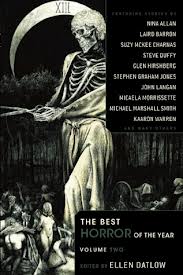
The Best Horror of the Year, Volume 2, Ellen Datlow (ed).

9781597801737
Night Shade Books, 2010
308 pp

softcover


I'm really liking this aimless reading thing; I love being all over the map with my book choices.  Good horror anthologies or novels are my secret indulgence; I love that feeling of dread that creeps up on me while I'm reading.  I save these books for reading in the dead of night when it's quiet.


I read the first entry in this series at the end of February and it was just plain bad, so I was happily surprised to find that there had been an improvement in quality between the publication of the first and the second volumes. There are five little gems that shine above all of the rest in this book -- so if you're into horror, you might want to check it out.

The Dance of the Seagull, by Andrea Camilleri

9780143122616
Penguin, 2013
277 p
originally published as La danza del gabbiano, 2009
translated by Stephen Sartarelli

Another favorite crime fiction writer of mine has a new novel out in translation, taking us to Sicily with  The Dance of the Seagull, #15 in Andrea Camilleri's excellent series of novels featuring Inspector Salvo Montalbano.  I haven't missed one of these books, reading them faithfully since book #1, The Shape of Water.  While they are definitely crime novels, they're also filled with the sights, sounds, smells and tastes of Sicily, and Inspector Salvo Montalbano happens to be one of my favorite characters in the crime fiction universe.  Definitely recommended, but best to read from the beginning.

Monday, March 11, 2013

The Death of Bees, by Lisa O'Donnell

9780062209849
HarperCollins, 2013
309 pp

Let me start my brief discussion of this novel by saying that I predict that it will be a runaway bestseller once word gets out about it. The Death of Bees is very easy to read, it moves very quickly, and it will capture the attention of people who are fascinated with stories about severely dysfunctional families or stories with young, teenaged characters at the center of it all.  From what I can tell by perusing the star ratings of this book, it is probably going to sell like hotcakes. 

Personally, I had heard of this novel and had planned to give it a pass, but it arrived from Powell's (along with an incredibly tasty jar of honey) in my latest Indiespensable shipment so I thought, well, okay, I might as well give it a go. I was admittedly mildly intrigued by the opening lines:
 "Today is Christmas Eve. Today is my birthday. Today I am fifteen. Today I buried my parents in the backyard.

Neither of them were beloved."
Hmmm, I thought, perhaps it's something along the lines of McEwan's Cement Garden.  As it turns out, it isn't.   After a few chapters, I came to the conclusion that this is definitely not my cup of tea and I  thought about putting it away unfinished, something I rarely do.  I'd even reached for another book before thinking that all of these 5-star ratings must mean something, so I picked it up again and read through to the end. It still wasn't my cup of tea, but overall, not because of the author, although I do think she missed the mark in a couple of places. The plain and simple truth is that I just don't like these kinds of novels -- especially ones geared (imho) more toward a mature young-adult audience or toward those who like women's fiction.  While it may be trendy, it's not my thing.

Set in Glasgow, the story is told through alternating points of view.  The two sisters at the heart of this story, Marnie and Nelly, take turns; Lennie, the next-door neighbor who takes the girls in when he thinks their parents have just gone off and left them also has a voice.  The story begins with the deaths of the parents and Marnie's realization that if the authorities discover their absence, the girls could be taken into care, so they construct a story that the parents have gone away and left them alone, but that they're planning to come back. After all, when Marnie turns 16, she can legally care for her sister and herself.   Meanwhile, they bury the bodies in the back yard, planting lavender over the graves.   Lennie has his own issues -- he was caught with a young male prostitute and now lives by himself; he's a very lonely old man who feels better being needed by someone. Both sisters deal with their childhoods and their parents' deaths in different ways; Lennie doesn't know the truth and tries to understand what it is the girls aren't telling him.  There are several twists to this story that gets darker as time goes on and as more players are introduced.  Thematically, the story looks at families and at grief; it also examines what it means to truly care about someone. 

To be fair, aside from the target audience thing, I felt that the story moved along very quickly,  never getting boring and the author throws in some dark humor at times. Some of the families other than Marnie and Nelly's also threw a light on different types of dysfunctionality -- for example, people who have well-paying jobs and live in nice houses who neglect their kids, a woman in a state of post-prison  religious mania who turns her back on her wayward son so he has to sleep on the streets, and a daughter who turned to her father in a serious time of need but was refused because the father had a reputation to maintain --  all make their appearances here.  Bringing all of this out was something the author did well.  But I discovered two major issues that I would consider problematic writing wise: first, I saw the big twist toward the end coming a mile off (sadly, I can't reveal what it is) and second, the end was just too pat, too sweet, too nice, too happy, whatever you want to call it. I get that she's offering a small glimpse of hope, but come on! That was just too way out there. 

As I said at the beginning, this book is probably going to sell very well.  I personally know people who LOVED this book -- all of them  YA and women's fiction readers so if that's where your reading interests lie, this is probably  the perfect novel.  I've seen it categorized in reviews as "depressing," which it could be, I suppose. I just wasn't that into it so I didn't really have that sort of connection to the story felt by most readers who lavished the book with heaps-o-praise.  Oh well!

Wednesday, March 6, 2013

The Golden Calf, by Helene Tursten

9781616950088
Soho Crime, 2013
340 pp
originally published as Guldkalven, 2033
translated by Laura A.Wideburg

If you're a fan of Helene Tursten's Detective Inspector Huss crime fiction series, you'll be happy to know that Soho Crime recently published book #6, The Golden Calf (#5 to be translated). If you're not, skip this entry.  This one had me going and kept me glued right up until the end which sort of didn't work for me.  You can read more here where I write about the crime fiction I read.   Let's just say this isn't one of my favorite Irene Huss novels.

Monday, March 4, 2013

How to Get Filthy Rich in Rising Asia, by Mohsin Hamid

9781594487293
Riverhead, 2013
240 pp


As always, my many thanks to the publisher and to LibraryThing early reviewers for my copy. 

How to Get Filthy Rich in Rising Asia is a story that charts the story of a man's rise in the world, countered by his losses, and it is also a story of love, although you might not guess that based on the title.  Nor would you believe it when you open the first page and find yourself reading about the nature of self-help books. In fact, you might be wondering just what the author is doing as you get more into the novel, because there are no character names, there is no name for the country in which all of the action is taking place, and the main character is addressed only as "You."  I first became interested in this novel last fall, when it was briefly excerpted in the New Yorker, and it whetted my appetite for more.  For me, there were no disappointments -- I loved this book, and I recommend it highly. 

The unnamed protagonist (the "You") of this novel first comes to our attention as a child in a rural village.  He is suffering from Hepatitis E caused by contaminated water. His father, who works as a cook in the city, decides to moves his family away from the village, separating the small family from the larger, extended clan. As time passes, the boy "you" attends school, only to discover he's smarter than his teacher, who never really wanted to be a teacher in the first place. His sister is unable to go to school, working as cleaning girl instead, biding her time until a marriage can be arranged; his brother is hired on as a painter's assistant, gaining marketable skills while he develops a brutal cough from spraying paint without proper protective equipment.  As a teen, "you" then finds a job delivering DVDs that have been pirated in a back room of a marketplace; it is while working here that he meets "the pretty girl."  They exchange phone numbers (he has a cell phone as part of his job), and get together to discuss movies, but the "pretty girl" has long been planning her escape, initially with the "help" of  a marketing manager but later by making connections with people whom she thinks will be able to help her with her goals of financial independence and fame.  When she leaves, "You" is distraught, but neither of them forget the other and dance into and out of each other's lives over several decades.  After a stint at a university,  where he grows a beard and aligns himself with a group of powerful idealists who inspire fear, he eventually finds the idealism wearing off for him in the face of a crisis.  Soon he is working as a salesman of  "non-expired-labeled expired-goods,"  but as the author notes,
 "...if you truly want to become filthy rich in rising Asia, as we appear to have established that you do, then sooner or later you must work for yourself.  The fruits of labor are delicious, but individually they're not particularly fattening. So don't share yours, and  munch on those of others when you can."

It is ultimately and perhaps ironically water that launches "you" into the world of bureaucrat patronage, big business, and wealth as he starts a business bottling it.  First it comes from the tap, despite cracking pipes, underground mains contaminated with sewage that causes deadly diseases; the "well-off" citizens of this city have turned to bottled water as a result.  At first, the unnamed protagonist has a small operation, boiling tap water before bottling it; he eventually moves on to becoming a water entrepreneur and making lots of money.  The big jobs that will bring him fame and the potential for more riches are dangling in front of him, for example, an exclusive housing developments in the city, "marketed, developed, and administered by one of a comprehensive network of military-related corporations," where the newest phase will have its own electricity plant and its own drinkable water, "Like you've gone to Europe. Or North America... without leaving home," ... "an inspiration for the entire country."  By now the city's aquifer is slowly being depleted, but "you" has become a rich man.

The use of the self-help format separates different periods of "you's" life and his material rise to entrepreneur under chapter headings that seem to be commonsensical and offer sound advice, for example, "Work for Yourself," "Befriend a Bureaucrat," or even "Be Prepared to Use Violence."  It also brings to light that while riches can be achieved, and success can be realized, there's also a flip side: loss. While "You" is steadily climbing the success ladder, his losses begin to mount: his marriage and relationship with his son are slowly disintegrating, and as he gets older, health and fortune begin to wane. While the story focuses on this character, the format of this book also allows the reader to project his story onto this unnamed country, and the growing pains it endures: health concerns, the mass move to the cities that changes traditional family structures and family dynamics, and among other things, leads to the construction of haphazard housing that as the author notes, probably wouldn't survive torrential rainstorms or earthquakes. Rapid growth and one's financial successes are caught up in webs of corruption, nepotism and graft that are inherent in every stage of the process (even "you's" elementary school teacher got his job through bribes and family connections in the bureaucracy); physical security comes from having a bodyguard prepared to shoot your rivals' hitmen or anyone else who might want you out of the way; then, of course, there are the ever-present environmental concerns that are pretty much ignored. The book as a whole also provides a framework for trying to understand a part of the world that most of us actually know very little about.

As I came to the end of the novel, one of the questions I took away with me was whether or not the unnamed protagonist's successes were worth the inevitable losses -- extending that concept outward I find  myself  hoping that this country will survive the downsides of its  attempts at its own rise in the world.  The powerful and continuing  love story between the unnamed character and the pretty girl holds the key to existing with a  measure of peace and stability among the chaos; that's all I'll say about this right now and leave it to you to read it for yourself. The book as a whole also provides a framework for trying to understand a part of the world that most of us actually know very little about. 

I loved this book; all in all, I found How to Get Filthy Rich in Rising Asia to be a very clever, well-written and thought-provoking novel. There is so much more to this book than I can encapsulate in a few paragraphs  here, which is okay, because the book is really best experienced via one's own imagination.

Friday, March 1, 2013

March: aimless reading time

This month, instead of perusing the shelves to find common threads among the books, I'm reading with absolutely no agenda. I can't even say what I might pull off the shelf in March -- it could be anything!  Here's what I'm currently working on:

How To Get Filthy Rich in Rising Asia, by Mohsin Hamid -- almost finished and absolutely loving it (I can already recommend it even though I'm still reading it)

The Dance of the Seagull, by Andrea Camilleri

Jasmine, by Noboru Tsujihara -- a couple more chapters and I'm done

I have the house to myself today so I'm off to read now. 


Monday, February 25, 2013

*The Book About Blanche and Marie, by Per Olov Enquist

9781585678884
The Overlook Press, 2006
originally published as Boken om Blanche och Marie, 2004
translated by Tiina Nunnally
softcover

"I think if we put all of our loves together, I mean my loves and Marie's, then an image of life itself would emerge, in the spaces in between."

The Marie in this book, a blend of historical fact and outright fiction, is Marie Skłodowska Curie, a scientist who, with her husband Pierre, discovered the elements polonium and radium, and  twice won the Nobel Prize.  Blanche refers to Blanche Wittman, who came to be Marie's assistant, after having  spent a number of years in Salpêtrière Hospital in Paris  for her "hysteria," in the care of Dr. Jean-Martin Charcot.  Blanche's "cure" was based on the rather odd belief at the time in stimulating/manipulating  women's ovaries and other lady parts.  Blanche was Charcot's favorite "performer," and the cover of this novel is a piece of a famous painting by André Brouillet that shows Blanche during one of her public "treatments." 


As the novel opens, Blanche, described as a "sort of torso, though with a head,"  having undergone several amputations due to her work with radioactivity, is dead, having "died happy."  She noted this fact in one of her three notebooks, colored black, red and yellow, collectively realized as the Book of Questions.  The main question Blanche seeks to understand in her writings is that of the nature of love -- her writings were meant to be a solace to "poor Marie," who, some time after losing her husband Pierre in an accident, started up an affair with Paul Langevin, a scientist-friend of the Curies. He was five years younger and married; eventually the truth came out and a huge scandal ensued that not only ruined her reputation but almost cost her the second Nobel.  Blanche notes that her own experiences will provide Marie with "the courage to face life," and will also save her from "the inner frostbite and scientific rigor that were about to kill her and her sanity."  As the author notes regarding Blanche,
"In the Book of Questions she wants to tell her story, to summarize and compare her experiences, partially from the hysteria experiments at Salpêtrière Hospital, partially from the physical chemistry ones under the guidance of Madame Curie, in order to create in this manner a healing portrait of the nature of love, which she compared to the nature of radium radiation and hysteria."
 Blanche has lost most of two legs and an arm, and her Book of Questions is written with the remaining hand that also helps her move about in the wooden box in which she spends most of her remaining days.  The two women are both damaged and have suffered for science and for their passions.  Inside the Book of Questions is Blanche's reflections on her past, including her time at  Salpêtrière and her examination of her somewhat strange relationship with Charcot;  her contemplation of Marie's problematic romance is also part of  her investigation.  As it turns out, the question cannot be answered, since according to Blanche, "love is not something a person can understand;"  it is ultimately the investigation itself that becomes all encompassing and in a sense, life sustaining for Blanche up until the moment of her death. 

But wait -- there's more. While the title of this book might lead you to believe that what you're about to read is  a novel of historical fiction about two women, one famous, one virtually unknown,  as  you delve more deeply you come across names and events that make you realize that in and around the stories of Blanche and Marie is a cleverly-designed work about the birth of the modern world. The new century makes its entry “with blood, with confusion, with reason, ... in an attempt to step into the dark future of humanity, " only to lose its "self assurance, its optimism about progress, its arrogance..." in 1914 with the advent of World War I.  As the author explores the timeless human forces of  love and death, healing and destroying, reason and irrationality, the little blue light of radium looms in the background as a symbol.  Marie's search for understanding the power behind this element might well be viewed as an allegory of her quest to try to understand the power behind love --  both of which contain the forces of destruction and curing alike -- a sort of double-edged sword, if you will. 

 I know I've way oversimplified things, and I didn't mention several things I've marked in my notes: the continuous imagery of amputation -- of things, of memories, of people;   the relationship of science to art;   the author's story of the two-headed Pasqual Pinon whose other head was named Maria and its relevance to the overall story,  and most especially the question of why people are continually drawn to forces that have the power to maim or kill. Frankly, this book could be an entire semester's worth of study on its own so there's no real way to encapsulate everything I've read here.

 From a casual reader's perspective, The Book About Blanche and Marie is  rather difficult reading at times; but in spite of having to go back slowly through several sections, I actually ended up liking this novel.  It is also my introduction to this author's work, and it  took some time to get used to his style where he tends to step into his work with his own personal interjections about his characters, or with seemingly  strange observations that feel out of place at first, but which come to make sense later.  The repetition that exists in this novel has a purpose but until I got the hang of reading it, I'll admit I was a bit confused. If  you need to have a cut-and-dried sort of historical fiction that goes from point A to point B, you will not find it here. It's what I call a "quirky" sort of read, and I spent a lot more time on it than I had intended.  While a number of people absolutely loved this book, for me it was a beyond-good, not-quite-great novel.


fiction from Sweden

Friday, February 15, 2013

*Going After Cacciato, by Tim O'Brien

9780767904421
Broadway Books, 1999
originally published 1978
336 pp

"What part was fact and what part was the extension of fact?  And how were facts separated from  possibilities?  What had really happened and what merely might have happened?  How did it end?"

Normally a book of 336 pages is nothing daunting  and usually about 2-3 days of reading time.  I spent well over one week on  Going After Cacciato, filled one entire spiral-bound notebook with notes and questions and went through almost an entire package of little sticky tabs for marking things I wanted to come back to later.  Because I felt that this is a book that I genuinely wanted (and still want) to understand,  I got up in the wee hours of the a.m. to read before anyone was up and came downstairs to interrupt me. I bought books about Tim O'Brien & books about approaching Vietnam War literature, I skimmed then downloaded copious amounts of scholarly articles about Cacciato, all to come back to later, and well, you get the drift here.  There is so much going on here that it deserves much more time and intense scrutiny than I've given it, and if that doesn't recommend it, I don't know what will. 


Considering my fascination and admiration for this novel, this book is best experienced by the reader, so what I'm going to say here is going to be relatively brief.  The novel opens with a haunting paragraph, a list of the deaths of people who were in  main character Paul Berlin's squad:
"It was a bad time. Billy Boy Watkins was dead, and so was Frenchie Tucker. Billy Boy had died of fright, scared to death on the field of battle, and Frenchie Tucker had been shot through the nose. Bernie Lynn and Lieutenant Sidney Martin had died in tunnels. Pederson was dead and Rudy Chassler was dead. Ready Mix was dead. They were all among the dead."
 Then in October, Cacciato, another platoon member, "left the war," ... "Split, departed." He had told Paul Berlin that he would be going off to Paris -- 8,600 miles, walking all the way. Cacciato's route was to take him
"up through Laos, then into Burma, and then some other country...and then India and Iran and Turkey, and then Greece, and the rest is easy."
The decision is made by the lieutenant that the squad will go after Cacciato -- and so it begins. Incredible premise for a novel about the Vietnam War, isn't it? As the squad makes its way on the 8,600-mile trek, at some point you begin to realize that things that happen on the way to Paris link to the squad's real war experiences in Vietnam, the second narrative strand in this book, which eventually tells the stories of how the ten men listed at the beginning died.  In the third thread, Paul Berlin reflects on the war and his place in it over one night on watch in an observation post along the South China Sea, and it is also there that he begins to work out the possibilities of "What happened and what might have happened," to Cacciato and by extension, to himself and the squad chasing after the AWOL soldier. Time moves slowly in the observation post, giving Paul Berlin space to realize that the "critical point" is that "It could truly be done."  Cacciato's flight also gives Paul Berlin time to reflect on the question of fear,  the soldier's constant companion, and courage:
"The issue, of course, was courage. How to behave. Whether to flee or fight or seek an accommodation. The issue was not fearlessness. The issue was how to act wisely in spite of fear. Spiting the deep-running biles: That was true courage. He believed this. And he believed the obvious corollary: The greater a man's fear, the greater his potential courage."

O'Brien has created a story that blurs the lines between reality and imagination, fantasy and fact, leaving it to the reader to try to sort it all out somehow.   Reality and facts are definitely present in this story, as are, believe it or not scenes of restlessness and tedium in the midst of war, but all are related in a disjointed, jarring sort of way that likely reflects the often surreal Vietnam war experiences of those who were there and how they processed internally what they saw and how they remembered things later.  On the flip side, there are several instances in this book that not only verge on but fall smack into the territory of the surreal.

As noted above, this is a novel that needs to be experienced individually -- while a number of readers were  totally turned off by the verge into the fantastical, for me it's probably one of the most powerful, well-written  books I've ever read.  Any book that wants to make me get into the head of the guy who wrote it or that keeps me thinking about it long after the last page is turned is more than worthy.