Showing posts with label Booker Prize longlist 2010. Show all posts

Friday, September 24, 2010

The last of the Booker longlist (briefly): The Finkler Question, The Betrayal, and In a Strange Room


Ever so happy am I today because I've finished 12/13 books on the longlist, and  I'm officially calling it quits. The thirteenth book hasn't shown up (I see a credit card refund in my immediate future) and because I'm dying to get to my newly-purchased Scandinavian crime fiction novels to take the edge off of my tired brain, I'm bringing down the curtain on the Booker Prize longlist. Ta-da. That's all folks. Nothing to see here -- go back to your homes. Finis.

The final three on the list were The Finkler Question, by Howard Jacobson, Betrayal by Helen Dunmore, and In a Strange Room, by Damon Galgut. Following are my three very brief reviews.


The Finkler Question, by Howard Jacobson
  1408808870
Bloomsbury
2010
320 pp.

  Julian Treslove is a rather mediocre man who has had a string of unsatisfying and unspectacular jobs (including the BBC radio 3), and now works as a double for famous people.  His best  friends are Sam Finkler, from his school days, and Libor Sevick, former teacher to Treslove and Finkler.  Finkler and the older Libor have both been recently widowed; Treslove has had a rather unsuccessful and boring love life,  and considers himself an honorary widower around his friends.

Finkler is a Jewish pop philosopher on television and in print; he's also a member of  "ASHamed Jews," who take a great deal of pride in being ashamed of other Jews who are ardent supporters of Israel and Zionism.  Libor used to hobnob with the stars in his younger days. After an evening together, which the men spend trying to transport themselves back in time when they had nothing of value to lose (pre-marriage, pre-children), philosophizing about whether or not it's better not to have experienced happiness so that there's little to mourn in the present, Treslove is walking home, thinking about the depths of sadness evoked from that evening.  Out of nowhere he is mugged, and and he thinks his attacker (a woman...oh, the indignity of it all!) made an anti-Semitic remark as she was robbing him. Treslove is not Jewish, but wonders if there was something, unbeknownst to him, which would have caused her to assume he was.  Treslove then makes the decision become a Jew, a decision which changes his life from this point on.  His observations of his friend Sam Finkler lead him to call Jews "Finklers," hence the title.


While the author explores anti-Semitism on the streets of London (even among Jews!) as well as Zionism and Judaism and how Jews define themselves,  this book is also about friendship, love, loss and grief. There's a great deal of ascerbic wit and some incredibly funny moments, but there's also an undertone of deep sadness which runs throughout the entire book that never quite seems to let up. The Finkler Question is a good book, very well written, and one which offers its readers a great deal to think about.

***

The Betrayal, by Helen Dunmore
9781905490639
Penguin
2010
330 pp.

The Betrayal is set in Stalin's USSR, beginning in 1952.  The story focuses on a couple, Andrei, a doctor  and Anna, who teaches at a nursery school.  Andrei and Anna spend their days trying to do what everyone else in that period of time tried  to accomplish (with varying degrees of success):  to keep a low profile while going about their daily work and home lives.  It is becoming increasingly difficult for Andrei and Anna and Anna's younger brother Kolya to do so -- at home, they attract the wrath of their neighbors when Kolya plays the piano and at work, Anna has been told she needs to advance herself by taking some courses at the university.  This is not such a bad thing, but Anna's got secrets that a check on her family background might uncover, and she doesn't want to risk coming to someone's attention.  Andrei also goes through his normal daily routine at work, but  trouble still manages to raise its ugly head when a colleague of his requests that he take a look at a very ill boy.  As it happens,  the boy's father is none other than Volkov, who is one of the highest officers of the Soviet secret police.  Andrei realizes that he is in a most untenable position, especially when it turns out that Volkov's child needs immediate treatment for cancer.  Although everyone he knows tells him to walk away, he finds that he cannot -- with some rather unsettling consequences.


I liked it, but I wasn't wowed, unlike everyone else who seems to have fallen in love with this book and given it 4+ stars.  I know I am the lone stranger here, but I can't help it.  It's not really the author's fault -- it's just that the story was a bit too light for my taste, not as much of an in-depth look at this period as I would have hoped for.   Dunmore is a skilled writer, but if I were going to recommend fiction about life under Stalin, I think I'd go with Solzhenitsyn's The First Circle, Platanov's The Foundation Pit, Vassily Grossman's Life and Fate and Shalamov's Kolyma Tales. But if you like your historical fiction on the lighter side, then you'll probably love The Betrayal.  

***

In A Strange Room, by Damon Galgut
9781848873230
Atlantic Books
180 pp.


In A Strange Room consists of three novellas.  The first is called "The Follower," in which the narrator (also named Damon) is in Greece, visiting the ruins at Mycenae, and on the empty road meets a fellow traveler, Reiner, going the other way. They strike up a conversation, and Reiner tells Damon that he has to catch a train that night. However, when Damon arrives back at the hostel where he is staying, he finds Reiner there, having missed his train. Eventually Damon returns home to South Africa where he finds himself thinking of Reiner, and decides to invite him to come and visit. The two decide to travel to Lesotho where they embark on a series of long hikes with unforeseen consequences.  The second story is called "The Lover." Once again Damon is traveling, this time in Zimbabwe -- "no particular reason or intention has brought him here."  At a bar at Victoria Falls he meets a group of fellow travelers on their way to Malawi. He decides to go with them, and realizes that they don't know each other but have only banded together for safe travel. However, he soon ditches this group for another group of three people who he keeps bumping into -- Alice, Jerome and Christian. When the trip is finished, Damon decides to go home rather than to Greece where he's been invited by Jerome and Alice, but is struck with instant regret. So some time later, he takes them up on their offer for a visit to Switzerland. The last story in the book is "The Guardian," which finds Damon heading for Goa (India) with a good friend of his named Anna, "somebody he loves and who makes him laugh.  Somebody he wants to protect." He has promised Anna's partner he would watch over her carefully, because Anna's already "gone off the rails" in the past.  But Anna's troubles cause her to start  “losing the plot, living in fast motion, speeding along” and eventually, things come crashing down, spiraling out of control.

Besides the experience of traveling with someone tying together these three stories, in an interview, Galgut noted that the unifying theme in these stories is that there is a "spectrum" of  categories  people in "intimate" relationships fall into: power, love, and guardianship.  I would add that there's a theme of dashed hopes in a "what could have been" sort of way that seems to run throughout as well.

 In a Strange Room is not a novel filled with action, but rather a story told in a quieter, understated tone.  The narrator relates his story often as if he's watching himself from another vantage point,  so that sometimes he's speaking in the first person, and the telling changes to a third-person narrative, where "I" becomes "he" or "Damon." And as I was reading it, I couldn't help but wonder if this was a disguised piece of autobiography, only to learn after finishing the book in the above-mentioned article that the author believes that
the process of memory is also a form of fiction. Part of the point of this book is that it should be published as fiction and make people reflect on the boundaries between fiction and non-fiction.
 And he's absolutely correct, now that I think about it.  I really liked this book as a whole, although my least favorite story was the second one, because it seemed that the longer it went on, the less powerful it became.   What comes out of  this book is honest emotion, which I appreciated.  Definitely recommended.

***


Friday, September 17, 2010

the longlist progress: T minus 3 and counting....and a giveaway to celebrate

The Booker Longlist 13 -- it's almost over! Yay!


In the wee early hours of this morning I finished Damon Galgut's In a Strange Room, and two days ago I finished up The Finkler Question, by Howard Jacobson.  So I'm almost finished with the longlist, have one more to go on the shortlist, and plan to celebrate when it's all over with a stack of deliciously mindless horror novels until October 1.

Here's the list so far:


1. C, by Tom McCarthy -- shortlisted

2. In a Strange Room, by Damon Galgut (to be reviewed shortly) --- shortlisted

3. Room, by Emma Donoghue -- shortlisted

4. The Finkler Question, by Howard Jacobson (to be reviewed shortly) -- shortlisted

5. Parrot and Olivier in America, by Peter Carey -- shortlisted

6. Trespass, by Rose Tremain

7. February, by Lisa Moore

8. The Slap, by Christian Tsiolkas
9. The Thousand Autumns of Jacob de Zoet, by David Mitchell

10. Skippy Dies, by Paul Murray  -- my favorite of the entire list! I'll repeat my bummedness at it not getting to the shortlist.


Reading now:
11.  The Long Song, by Andrea Levy -- shortlisted


Left to go:
12. The Betrayal, by Helen Dunmore
13. The Stars in the Bright Sky, by Alan Warner


--and now, the fun stuff --

Giveaway of Room, by Emma Donoghue

In honor of finally getting to the last 3 books on the longlist (which was no simple task, mind you), I'm marking the occasion by giving away a copy of Room, by Emma Donoghue.  I will be selecting a winner on September 25th.  If you'd like to try for a chance to win, all you have to do is leave a comment on this post with your blog name by September 24th.  If you don't have a blog, then please leave a comment and send me an email with your contact info.  International entries are welcome.  Note: YOU DO NOT HAVE TO SIGN UP AS A FOLLOWER.  I enjoy people's comments, and I really like the wonderful people I've "met" since I started this reading journal, but followership is not mandatory just to win a book!

Saturday, September 11, 2010

Trespass, by Rose Tremain

9780701178017
Chatto and Windus
253 pp.
2010

(read in August)

Veronica Verey (known as V) and her friend/lover Kitty live in a small village in the south of France. V is a garden designer, currently at work on a book called Gardening Without Rain. Kitty is a not-so-successful watercolor artist studying photography. The two find companionship in each other. Their home is an old stone farmhouse, and from the terrace they’re afforded a view of the beautiful Cévenne hills and "blinding red" sunsets. Kitty's happiness is "absolute" when they spend time on their terrace, drinking wine, taking in the view, listening to the birds -- but Kitty is also insecure, creating a sense of uneasiness between herself and V.

Audrun Lunel and her brother Aramon  live not far from V and Kitty.  They are in their sixties, living in the Cévennes village of La Callune where their family has owned and worked the land for generations. Audrun's father had left her a piece of the family land as her very own -- a wooded area where she built a bungalow -- for reasons I will leave unmentioned. Aramon remains in the family home, the Mas Lunel, once a U-shaped house, now only the back of the U remains. Now a drunken and broken old man, Aramon has virtually given up, preferring to sit and watch television while he drinks. Aramon has decided to sell what's left of Mas Lunel, learning that he could get a hefty chunk of money from foreign buyers for the place.  Although Audrun will still have her patch of woods and her bungalow, the thought of losing her childhood memories of her mother horrifies her beyond belief, and she can envision the changes that would come if Aramon were to sell the house. 


Enter Anthony Verey, Veronica's brother.  Anthony is 64, with a failing London antiques business. He used to thrive on the knowledge that people were envious of him and filled with admiration of his celebrity; now in his 60s, he realizes that what he sees now in the eyes of others is merely pity.  Even the young and beautiful boys he entertains no longer make him feel good -- in fact, seem to have the opposite effect.  Anthony also realizes that this is no way to continue on, and decides he's got to have that final shot at happiness.  As in the past, he turns to his sister V for rescue. He decides he will go stay with V at her farmhouse for a while; then once there, decides he should have a place of his own and make a fresh start.  This decision serves as a catalyst for tragedy as a series of events unfolds that begin to snowball out of control. 


Trespass is aptly titled; there are many varied forms of infringements that are threaded throughout the novel: emotional and physical, native and foreign, and even the boundaries of truth are encroached upon and violated. There's also the concept of trespass in terms of sin that is explored as well.  Another major theme is the past -- for some people the past is something they can never let go of while others want to escape it and move on.


The sense of place in this book is very well executed. The characters started out extremely strong, standing as unique individuals caught in their own lives as well as in webs of complexity within the scope of their relationships to others. The story was also strong and taut at the beginning, so much so that I couldn't put the book down.  However, in the second half of this book, at some point (for me, anyway) things became so incredibly foreseeable I continued reading just to confirm what I'd already figured out.  And it is also at this juncture that the characters started falling apart -- becoming just as predictable as the story and losing the depth that gave them so much life at the beginning.  But that doesn't mean that this is a bad novel. Au contraire; it is an incredible story and I found myself really liking it. And it's one I'd have no problems recommending. 


(so sorry about the font change..I have to figure out how to write in MS word & have it transfer with no changes. arrgh!)

Friday, September 10, 2010

February, by Lisa Moore

0802170706
Grove Press/Black Cat
February, 2010
320 pp.


(read in August)


The combination of loss, grief and the necessity of moving on in life (and love) is the main focus of this novel, which focuses on Helen after the death of her husband Cal in 1982.  Cal worked on the Ocean Ranger, an oil rig off the coast of Newfoundland, and was there when it went down due to bad weather and human error. All hands were lost; in horrible weather that left no opportunity for rescue by ship and water that can easily produce hypothermia in minutes, no one was saved (you can read about the Ocean Ranger here).

Much of the story is told through flashbacks, which bounce backward and forward in time, not very linearly. Helen has put off her grief for some time, and the book examines how she coped throughout the years, creating one of three separate plotlines that run and interweave constantly throughout the novel. Much of the time she spends trying to picture exactly what happened on the Ocean Ranger, and in the midst of trying to figure out what caused the rig to sink, she thinks of Cal doing his job or playing cards with his workmates on the rig, or Cal dying alone, in the icy water of the North Atlantic.   At the time of her husband’s death, she had three children and another one on the way – her struggle to raise them alone and her children in general take up a second narrative strand, especially in the present:  Helen's son John has just found out he’s going to be a father after a trip to Iceland. The call wakes her out of a deep sleep, both in terms of reality and metaphorically.    The third storyline begins as Helen’s sister convinces her that her house needs renovating (“you want this place to be condemned or what?”) and Helen meets the carpenter Barry. 

Grief consumes Helen, and Moore’s writing allows the reader to feel what Helen feels. Everyone can relate to the loss of a loved one, especially a partner/wife/husband, even more so when that loss comes unexpectedly before you think it should.  While the author explores the nuances of grieving, loss and love, and expresses them well through her talented writing, there’s just something more dynamic and complex that’s missing here.   While it may work on an emotional level, I noticed a surprising lack of real development of  characters who are most central to Helen’s life – her daughters.  John’s child’s mother, Jane, gets more air time than Helen’s own daughters, as does John himself, which just didn’t feel right. Even considering that their relationship was difficult and strained at times, I would have expected more from the mother-daughter aspects of this story.  This books also at times has a kind of (dare I say what I really think??) "women's-fictiony" feel to it that I didn’t particularly care for.  

What might have worked better for me would be a book about the men on the Ocean Ranger -- their reasons for being there, their camaraderie or conflicts, their last moments and the people they left behind. Someone should write that story.

But as always, so many people loved this book and gave it high ratings, so perhaps it will do well among the general-reading public. I'm just a demanding reader, and  this one just didn't do it for me.

Saturday, August 21, 2010

Room, by Emma Donoghue

9780330519014
Picador
2010


--warning-- this review may contain spoilers -- so beware


Jack is a five year old boy who lives in an 11 x 11 space with his mother that Jack calls "Room." Not only is this place their home, Room is the only world that this child has ever known.  He has never been outside Room, and although he and his mother (Ma) have a television, Ma has told him that what he sees on the tube is not real.  The door to Room is always locked.  Although Jack doesn't know this, Ma has worked very hard to make life as normal for Jack as it possibly can be given the circumstances -- Jack and Ma eat, sleep, exercise, play games, sing songs, have lessons and conversations all within Room's confines.

We learn about life in Room through Jack, who narrates the story.  The routines differ only sometimes at night, when the man that Jack has dubbed "Old Nick" occasionally shows up and Jack needs to go inside "Wardrobe," where he has to sleep, until Old Nick is gone again. Jack doesn't like Old Nick and instinctively feels something rather sinister about the man's presence; at the same time he knows that Old Nick is the one that he and Ma depend on for food, clothing, and the occasional "Sundaytreat."  Jack's observations of Room, his world view within this space, and his conversations with Ma are often surprisingly adult in nature, considering he's only five, but at the same time, the reader is still very conscious that Jack is just a little boy, still learning about and trying to make sense of things in his world, just like any other child his age.  But then one day, Ma decides to tell Jack the truth about some things, and makes plans to leave Room forever. The rest of the novel (which is not really giving anything away if you just look at the chapter headings) describes their escape from Room into a world Jack has never known, as well as its aftermath -- leading to collisions between what Jack has always believed was  real and what people are now telling him is real. And, just when you're comfortable thinking that this is only a work of fiction, FYI, Room is based on true events from Austria, the famous Kampusch kidnapping case.


I liked this book, but didn't fall in love with it the way most people who've read it have. At its heart,  it's a good story with a fresh premise.  Making Jack's eyes the ones through which the reader sees the Room world was a good idea -- there's much more immediacy to the story, making the reader wonder why they're there and what's going to happen.  Even though Jack's credibility often seemed a bit strained as a narrator due to his precocious and adult-like vocabulary, the fact that Donoghue also showed his child side makes this work.  The fact that Donoghue did not roam into the realm of the tawdry, either about the abduction or especially during Old Nick's night-time visits is to her credit -- doing this would have only cheapened the story to the point where I would have probably put the book down. Yet at the same time,  the second half of the book doesn't quite manage to hold on to the taut and clever construction of the first part, which had me reading nonstop. I won't say anything more specific, because I do not wish to give away the entire show.  


I predict that when this book hits the US next month it is going to sell big time. It comes on the heels of several widely-reported cases of kidnappings and victim rescues. It is designed to tug at heartstrings, and the author does that well. Finally, quite frankly, it's very reader friendly.   There isn't a lot of flowery prose, it's easy to read, resonates well with the fears of modern-day parents, and is generally suited to a wider audience of readers than most books that show up on the Booker Prize longlist.  I think it will do very well. That's not saying I think this is a great book, but I think it is going to be quite successful.

Wednesday, August 18, 2010

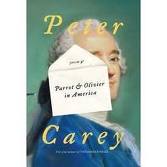
Parrot and Olivier In America, by Peter Carey

9780307592620
Knopf
2010
380 pp.


Parrot and Olivier in America is composed of two narratives that interweave throughout the novel: that of  Olivier-Jean-Baptiste de Clarel de Barfleur de Garmont, he of French aristo parentage, and that of  John Larrit (known as Parrot or sometimes Perroquet), son of an English  journeyman printer and a mother long dead.  Olivier's family were nobles who did not flee France during the revolution, but went to live in hiding in Normandy, so that when the monarchy eventually returned, their political position was tenuous. It became even more so when the last of the Bourbons (supported wholeheartedly by Olivier's mother) was later overthrown during the July Revolution of 1830. When Garmont was in his 20s and started attending lectures given by Francois Guizot, an activity deemed too politically dangerous for the young and naive man, his mother decided to ship him off to America for his safety:
You are a Garmont...the liberals see you and have no doubt you are a spy. The monarchists see you and know you for a traitor. You are in danger (77).
Ultimately his parents secured for him a commission to write on the state of American prisons, and create a report on his findings for France. Olivier, who as a child was a hypochondriac extraordinaire, never far from his Qianlong bowl of leeches, tends to be whiny and priggish, considers himself as a victim of the French Revolution, and has little to no understanding of others who are outside of his class and station.  Yet at the same time, there is a bit of a pathetic side to Olivier: he really has very little control over his own life -- everything is always decided for him by others.

Parrot, who as a young boy had escaped when his father and others were arrested in Dartmoor and ultimately executed for forging bank notes, had run across a Monsieur de Tilbot, who offered him help (eventually sending him off to Australia, promising that one day he would return -- the full account of which comes later in the story). As it so happens, Tilbot is also an acquaintance of the Garmont family, and turns out to be the initial connection between both characters. Parrot is older than Olivier, is an artist more firmly rooted in the working class, and in general understands the world better than his aristocratic counterpart. Parrot, a long time now in Monsieur's service, is called upon to spy upon Olivier while he attends Guizot's lectures. When Olivier's friend Blacqueville is killed defending their collective honors,  it is Parrot who is called on to escort him to America and to protect him while also serving as his secretary. And thus Parrot and Olivier come to America (but not until page 141!) -- and the rest of the book continues from there, where this odd couple of sorts come to realize the positives and negatives of living in a democracy and eventually come to terms with each other.

 I have to confess to never having read de Tocqueville (although I am familiar with many of his ideas on democracy), so at the end, when the author notes
The author's debt to Tocqueville himself will be obvious to scholars who will detect, squirreled away among the thatch of sentences, necklaces of words that were clearly made by the great man himself,
I find myself definitely not in the category of one of these "scholars," and perhaps I missed a thing or two along the way.  [The London Review of Books for August has an interesting take on this aspect of the novel if you're interested.]  But really, I don't think it makes that much of a difference while you're reading this book (unless, I suppose, you ARE a de Tocqueville scholar and you find things with which you may disagree or dislike about Carey's treatment).

I had a few minor issues with this novel. First, the book tends to lag at times -- for example, in the scenes where Olivier travels from place to place with Godefroy -- to the point where I found myself skimming to get to the next part, and there were other situations as well where the action was a bit dull.  Olivier's character, although drawn well, was rather aloof and often unreachable.  And then there's the little twist at the end. Just when I thought I had control over how I felt  about both main characters, Carey knocked the wind out of my sails for a while and made me have to do a rethink. But overall, I genuinely liked this book. When Parrot's first account began, I remember thinking how much I liked the feel of the narrative, as if someone were actively engaged in storytelling. Carey's judicious  use of imagery (especially of the birds) ran throughout , as did his constant allusions to the love of art. I also enjoyed his scenes that seemed to be taken right out of Dickens, especially in the case of Watkins and the forgers at the beginning.

 And I have to say also that I enjoyed the little barbs Carey throws out about the current situation in the US, especially when one of his characters notes that
America does not need either leadership or deep laid plans or great efforts, but liberty and still more liberty. The reason for this is that no one yet has any plans for abusing liberty. But wait, monsieur. It may take a century, but le fou viendra.
Take that as you will. My money's on W (pronounced "dubya").

Despite my minor issues with this novel, Parrot and Olivier is a clever philosophical debate about the pros and cons of democracy woven into a nice piece of historical fiction that will make you think about things long after you've put it aside. 

Tuesday, July 27, 2010

The Booker Prize Longlist is announced

the booker longlist, 2010 
Every year I look forward to the release of the Booker Prize longlist.  Over the last few years, I've read the works of some excellent writers who've since become some of my favorites.  The longlist also determines what I'll be reading for the next two months. And it's here.

 According to the website for the Man Booker Prize, a total of 138 books were considered for this year's Booker Prize longlist. Out of those, 13 made it: 


Peter Carey Parrot and Olivier in America (Faber and Faber)
Emma Donoghue Room (Pan MacMillan - Picador)
Helen Dunmore The Betrayal (Penguin - Fig Tree)
Damon Galgut In a Strange Room (Grove Atlantic - Atlantic Books)
Howard Jacobson The Finkler Question (Bloomsbury)
Andrea Levy The Long Song
(Headline Publishing Group - Headline Review)
Tom McCarthy C (Random House - Jonathan Cape)
David Mitchell The Thousand Autumns of Jacob de Zoet  (Hodder & Stoughton - Sceptre)
Lisa Moore February (Random House - Chatto & Windus)
Paul Murray Skippy Dies (Penguin - Hamish Hamilton)
Rose Tremain Trespass (Random House - Chatto & Windus)
Christos Tsiolkas The Slap (Grove Atlantic - Tuskar Rock)
Alan Warner The Stars in the Bright Sky
(Random House - Jonathan Cape)


The bad news is that I've only read two of these (Thousand Autumns of Jacob de Zoet, The Slap). The good news is that I own a few of the others, so at least I can get a start before I have to turn to The Book Depository for the rest. So now, I guess it's time to get reading.