
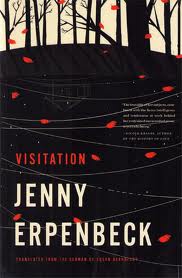
New Directions Publishing
2010
Originally published as Heimsuchung, 2008
translated by Susan Bernofsky
"As the day is long and the world is old, many people can stand in the same place, one after the other." -- Georg Büchner
"If I came to you,
O woods of my youth, could you
Promise me peace once again?" -- Friedrich Holderlin
"When the house is finished, Death enters." -- Arabic proverb
"If I came to you,
O woods of my youth, could you
Promise me peace once again?" -- Friedrich Holderlin
"When the house is finished, Death enters." -- Arabic proverb
Opening with the above epigraphs, Visitation is a rather stunning, although very short, novel of historical fiction that offers the stories of the inhabitants of a lakefront summer house in the woods of Brandenburg through the movement of time and history in Germany. The prologue opens twenty-four thousand years ago with an advancing glacier, then progresses geologically over the years until the Brandenburg lakes began to form. As the land comes to be settled, it too follows a natural progression -- it is parceled off and sold, a beautiful home is built, land is added, subtracted, reparceled, etc. The slow and natural progression of the landscape stands in stark contrast to the rapid events that play out throughout Germany and all of its accompanying turmoil as decades pass, but at the same time, what ultimately happens to this land and to the house mirrors what happens in this country during the twentieth century.
It is on one of these lakes that a wealthy farmer owns a large tract of land, and his daughters are each slated to receive their own parcels as their respective inheritances. But the farmer sells off parts of the land designated for his daughter Klara in three parts, to a coffee and tea importer, a Jewish manufacturer of fine cloth and an architect from Berlin, who is the builder of a fine house of “quality German workmanship.” The rise of the Nazis and the second world war result in changes of occupancy and ownership once again, and the home is requisitioned by the Russian Army as the soldiers come into Germany to liberate the country. As the powers that be begin to contemplate and to build the Berlin wall, the land and the home begin another round of inhabitants under the collectivization policies of the government of the GDR (East Germany). The fall of the wall and its aftermath also bring about their own changes. Through the entire story, the house and the land undergo a series of transformations, and the only thing that remains constant is the character of "The Gardener," a somewhat mysterious and symbolic figure whose story of the work he does on the land is related after each chapter. The author offers brief but very powerful glimpses into the stories of the residents as they move in and lay down a foundation of memories and histories. Happy times spent there also serve as a safe haven and an anchor for some characters in times far removed from their carefree days on the lake. Through it all people live out their private lives in the house and on its grounds, often in contrast to the very public upheavals that have occurred in a century of Germany's history.
This novel is highly reminiscent of Simon Mawer's excellent novel The Glass Room, where the author brought the events of twentieth-century European history to a particular house. But Visitation is vastly different -- where Mawer's book set forth the events of history chronologically in a traditional narrative style, Visitation isn't what most readers would consider a "conventional" novel. It's based more on differing personal perspectives rather than a straightforward chronicle of events. Within each chapter, people and events often float back and forth in time with no warning, and it can be a little disconcerting until you feel like you have more of a bigger picture. Erpenbeck writes her chapters in long paragraphs, so that a single event and connected thoughts are covered, generally relating back to the opening of the chapter so that events can shift or things can get a bit tangential before the chapter circles back and is over. There are times when the prose seems to transform from narrative to melody, as the author often repeats certain lines like refrains from a poem or song. And just as the style becomes comfortable, the author gives the reader a jolt. There are a couple of times where this happens -- first in a heartbreaking chapter from the perspective of a little girl in the Warsaw Ghetto (the only chapter that takes place away from the house), and second in a most disturbing chapter from the point of view of a Russian army officer. There are a few parts of the book that may seem tedious -- pieces of folklore, official documents, minor details about the house and grounds etc., but these things genuinely fit into and enhance the story and should not be glossed over. The characters have their own personas and voices, each with his or her own story, thoughts and feelings, all most excellently captured by the translator, and you cannot help but get caught up in these lives.
It's a beautiful book, and all of the things that make it less than conventional -- plus Erpenbeck's focus on the landscape (if even briefly) "coming to resemble itself once more" despite all of the tumult in our private lives and the world in which we live -- are what appealed to me as a reader. It's a challenging book, but if your focus is on the bigger picture rather than a chapter here and there, it's ultimately a rewarding reading experience.
fiction from Germany


