Showing posts with label book reviews -- American fiction. Show all posts

Monday, November 25, 2013

*Messiah, by Gore Vidal; *Survivor, by Chuck Palahniuk


We're finally moved in upstairs again since the remodel (yay!), so  I can find everything once more and now I actually have time to get back to the books about fictional cults I've set aside to read this month. I think I'll be carrying the list into December, because there are quite a few more I want to get to.  For now, here are two incredible novels that I most highly recommend.

Up first: Gore Vidal's Messiah.


9780141180397
Penguin, 1998
originally published 1954
256 pp

paperback

"If this thing spreads it will become organized. If it becomes organized, secondary considerations will obscure the point."

 If ever there was a reason to take a break  from reading what's on the New York Times bestseller list or  from current fiction, this book is it.  Going onto the favorites list for 2013, this novel is simply amazing.  Considering it was first published in 1954, it's surprisingly current and definitely way ahead of its time.  In this book, a new religion is born, and a simple message offered by a charismatic young man becomes organized, publicized, bureaucratized and ultimately bastardized before it encompasses the entire non-Islamic world.  It's highly satirical, funny in a dark humor sort of way, and makes you appreciate how perceptive this author must have been, considering all of the events coming out of  messianic cults over the last few decades.

Eugene Luther (which is actually Gore Vidal's real name) has been living in Egypt for the last fifty years under an assumed name.  He is working on an account of "that original crisis" that sent him there, which began when he was introduced to a former embalmer by the name of John Cave ("a pair of initials calculated to amaze the innocent").   Luther meets him through Iris Mortimer, a woman to whom he was introduced by another character, Clarissa.  On a visit to California,  he first hears Cave speak at a small gathering, and somewhat "against his will" Luther realizes that he was totally absorbed.  As Iris notes, "There's something in oneself which stirs and comes alive at his touch, through his agency."   Cave's message is relatively simple: "it is good to die."  This was the sole vision of John Cave, at first anyway; everything changes when Cave is put in the hands of  publicist Paul Himmell and his erstwhile partner, Jungian analyst Dr. Stokharin, and Cavite Inc. is born. It's Iris who notes that
"a society which knows what we know, which believes in Cave and what he says, will be a pleasanter place in which to live, less anxious, more tolerant." 
Himmell puts Cave on television and his popularity soars -- but to Himmell and his investors, Cave has become a product. While Luther has misgivings about the whole religion phenomena, telling the Cavite Board of Directors that they will
 "... do more harm than good by attempting to supplant old dogmas and customs with new dogmas. It will be the same in the end, except that the old is less  militant, less dangerous than a new order imposed by enthusiasts,"  

he readily accepts being drafted to supply background on Cave, to give him a "respectful ancestry," and soon he is also drafting dialogues, supposedly containing doctrine that becomes the basis of "Cavesword," the new religion. Millions of people are enticed by Cave's TV presence, and Cavesword spreads like wildfire, despite threats posed by leaders of Christianity, and despite Luther's growing misgivings.

But Cave sells -- and  becomes even more popular when Cave, a natural recluse,  is kept away from crowds allowing a mystique and mythology to grow.  It isn't long before Cavesword spawns centers in all major cities run by Residents and Communicators; nonconformists are "swayed" toward Cavesword in these places; eventually they become centers where practitioners can commit suicide.  As the story gets closer to why Luther is living in Egypt under an assumed name, it also starts taking on even more frightening tones.

This is, of course, a barebones outline of plot; this is another one you really can't get a feel for without reading it, but Messiah is simply put, an outstanding novel.  It seems to parallels the rise of Christianity, including the dissenters, the overlaying of old traditions to make new ones, the schisms, and mythologies that grew out of historical reality.  It examines the relationship between postwar American anxieties and the need for some kind of larger-than-life solution to offer people beyond the old, superstition-based religions.  It also looks at television's ability as the ultimate medium of persuasion -- considering that this book was written in 1954, that's an incredibly farsighted vision on Vidal's part.  But really, the best thing about this book is the realization that comes to Luther as he comes to understand his real role vis-a-vis  John Cave; sadly it's at the end so I can't really spill it.  It is however, a revelation that had me thinking about this novel long after I'd finished it -- in fact, the same is true of the entire book.  There is so much more to discuss, but if I wrote all I really wanted to, it would be more like a paper rather than a review.  Messiah is also first book I've ever read by Gore Vidal, and I absolutely love the way he wrote -- so much so that I've already picked up two more of his books.  It's as good or better than much of the fiction coming out currently, so if you're into great writing, excellent plotting and a story that causes you to sit and mull over what you've just read, you really can't make a much better choice than this one.  It shouldn't be pooh-poohed just because it's nearly 60 years old ... you'd think after reading it that the author somehow had access to news of the future.  Superlative. That's my final word.


Next:  Survivor, by Chuck Palahniuk


 9780385498722
Anchor Books, 2000
(originally published 1999)
289 pp

paperback

"You're going up and up and up and not getting anywhere. It's the illusion of progress. What you want to think about is your salvation." 

Going from Vidal's sublime Messiah to Palahniuk's ridiculously sublime Survivor isn't such a great leap, really.  There are a few shared ideas between the two books, for example, the importance of television as a medium for publicity and maximum exposure, the "messiah" as commodity in the hands of publicists and agents, and the reimagining of historical fact into a mythology designed for public consumption.  At the same time, only Chuck Palahniuk can write like Chuck Palahniuk, throwing in some very pointed barbs at American lifestyles.  As I noted somewhere, this book has some very disturbing scenes, but god help me, I couldn't help but laugh.

If you haven't yet read this novel, you might get a little confused like I did when I opened the first page. I thought my book had been screwed up in the binding process -- it starts on page 289, with chapter 47.  It's gimmicky, but it really does work.  Survivor is the story of Tender Branson, who, when we first meet him, is on an airplane minus passengers and pilot, the former having been deplaned shortly after takeoff and the latter having parachuted after giving tips to Branson about how to keep the plane in the air after the pilot jumps, the amount of time before all four engines flame out, etc.  Branson is the sole occupant of the plane, and is now telling his true life story to the airplane's black box which will survive the inevitable plane crash.  He wants to get it clear right away that he is no murderer; getting from the beginning to the end when he finally reveals the reasons behind clearing his name is the journey the reader makes through the novel.

And what a story it is.  Prior to sitting in the cockpit, Branson's adult life was one as a "full-time drudge," and part-time god."  His day job was slaving away at housecleaning for wealthy employers, guided by a day planner, so that at any given hour of his workday, he and his employers know what he's doing. He's interrupted periodically by calls from his boss, who asks him questions about such topics as how to eat lobster correctly at an upcoming dinner, which forks to use, that sort of thing.  Tender Branson is a whiz at home economics; he spent his life being schooled in running the perfect home.  He is also, as we discover shortly after meeting him, a member of the federal Survivor Retention Program, which affords him a caseworker with whom he meets each week, a tiny apartment with a shared hallway bathroom, free government cheese and a bus pass.  Branson grew up in the Nebraska church district colony of the Creedish; at age 17 he was baptized and sent out as a labor missionary.  This was the common practice of the Creedish; all boys but the first-born sons (all named Adam)  went out into the world to work and shared the name of Tender. The girls who were not chosen as wives for the first-born sons went out to work as well, sharing the name of Biddy.   Back home, the Adams and their wives had children, children and more children, and the children spent their lives learning a particular trade.  There were rules for living on the outside, though -- no dancing, no listening to broadcast media, and the biggest one of all was this one:
 "If the members of the church district colony felt summoned by God, rejoice. When the apocalypse was imminent, celebrate, and all Creedish must deliver themselves unto God, amen."
While Tender Branson is cleaning grout and getting bloodstains out of leather, the word comes that the Creedish in Nebraska have been delivered; he is taken into the Survival Retention program so that he doesn't off himself.  There are rashes of suicides among the survivors, and at some point, Tender becomes the only surviving member of the cult (well, as far as the authorities know), and thanks to a savvy agent whose job it is to make cult suicide look "fresh and exciting every time around,"   is turned into a new messiah for the people.

As Tender's lifestory is recorded for posterity, the author takes potshots at different facets of American culture that blend into Tender's experience.  For example, while being refitted as a "new guru" for people who need to "make sense of their risk-free boredom of a lifestyle,"  he climbs the "stairmaster to heaven," and is wardrobed, told what to say, and pumped full of botox, steroids, drugs etc in order to make him media perfect. As his agent tells him,
"Nobody wants to worship you if you have the same problems, the same bad breath and messy hair and hangnails as a regular person." 
Sitting in the cockpit, Branson reflects that "Reality means you live until you die...The real truth is nobody wants reality."

There are also riffs on diagnosing yourself via the DSM with the disorders of the day, things people pray for here combined into his "Book of Very Common Prayer,"  people being so busy with working and making money that they don't have time to enjoy their gardens, but one of the biggest ideas that comes out of this story is based on how to find salvation in the face of  boredom that comes from sameness  and having no control over your own life.

As I said earlier, it's not all funny, because there are some pretty tragic things described in here, but I defy anyone not to laugh while reading this book.  Fantastic novel -- if you haven't read it, go and get yourself a copy soon.  I love Chuck Palahniuk because he's such a great satirist, expressing questions about life in terms everyone can understand and recognize.  Another one not to be missed. 

Monday, November 18, 2013

book discussion: At Night We Walk in Circles, by Daniel Alarcón

9781594631719
Riverhead, 2013
384 pp


arc - my thanks to the publisher and to LibraryThing's early reviewers program

"...the play is different every time."


Some time ago I read this author's Lost City Radio, and loved it. Absolutely. Now he's back with At Night We Walk in Circles, and I loved this one even more. The blurb describing what's on the inside doesn't even come close to describing what actually happens in this character-based novel, which I would say focuses largely on identity, how past events come to be re-imagined, and the effects of blurring the thin line between reality and artificiality.

Set in a South American country somewhere (likely Peru based on a number of clues in the story),   the novel opens with the story of Diciembre, a theatrical group formed by a group of "radical students" at the city's Conservatory during the war. Their slogan was "Theater for the People," and they often went out into the "conflict zone," where'd they perform plays.  It was risky, but then again, being in the city also had its hazards: Henry Nuñez, the lead actor and author of the play The Idiot President, was arrested and sent to prison. His crime was one of "incitement," and he remained there from April through November, 1986, incarcerated as a terrorist.  From his prison cell, he made a radio broadcast, a "jailhouse interview" heard by many people, but by one person in particular who at 8 years old, was so impressed that Henry became his hero.  This is Nelson, who became intrigued about the occupation of "playwright," and who already had been making up his own dialogues about a girl with whom he was secretly in love, sometimes acting them out for his brother.  His brother explains that a playwright is someone who makes up conversations and calls them scripts, much like what Nelson had already been doing. It was then that Nelson decided that he wanted to do that as well -- it became his dream to become a playwright.

As the wartime curfews continued, Diciembre staged all-night shows such featuring such entertainments as "pop reworkings of Garcia Lorca," "stentorian readings of Brazilian soap opera scripts," and "anything that kept audiences awake and laughing through what might have otherwise been the long, lonely hours of curfew." As the 80s closed, and into the 90s, the troupe was a shadow of what it used to be. Things were changing in the country as well -- the capital had been "reimagined" in such a way that made it seem that no "unpleasant history" had ever happened there.   In  2000, the anniversary of Diciembre's founding prompted some of its "veterans" to mark the event somehow, and they decided it might be fitting to take The Idiot President on tour out in the countryside.  Henry was brought in from his now-quieter life to participate, "but only if a new actor could be found to join." His friend Patalarga is on board, and enter Nelson, now a theater student at the Conservatory, who ultimately gets the third part.  The timing is perfect and Nelson needs an escape, especially since  the woman he loves has set up house with someone else, and since the death of his father, he can't leave mother for his long-awaited trip to the US.  As the men wait at the bus station before they are taken away, Henry tells Nelson that they're "entering the world of the play now...its constructed  universe," and that he should "give in to it." As the narrator tells us, the beginning of the tour is  "when the trouble began." 

We learn all of this background and more  from a first-person narrator, who has only appeared some 13 pages into the book (well, in my ARC copy anyway).  His very presence signifies that something is not right -- that something has gone wrong with Nelson. Later, we also discover that he is trying to "decipher the mystery" around a "brief encounter" between himself and Nelson, by interviewing
 "his confidantes, his lovers, his classmates, people who'd seen fit to trust me, as if by sharing their various recollections, we could together accomplish something on his behalf. Re-create him. Reanimate him. Bring him back into the world." 
Using these interviews and words from Nelson's journals, he tries to piece together the chain of events that started with Nelson going on a tour for a play with two other actors, because he feels some kind of bond with Nelson.   The thing is though, that each person he interviews knows Nelson from a different vantage point, from  different situations in which Nelson has played different parts, so that eventually we find that there are  a number of different Nelsons.  How then is it possible to know the true Nelson? Is it possible at all?  Even he is aware of himself as an actor -- at the last drink he had with his brother he came to the realization that everyone, including himself, is always acting. When all is said and done, and as you come to the end of the story, you start to wonder if even Nelson really knows who he is any longer.   What I find striking about this book is that it is built around actors, their roles, performances, scripts and improvisations -- all tools used to create  illusion.

Re the title:  As Henry asks earlier, when he talks to the narrator about walking in circles while in prison,  "how do you set a play in a world that denies your characters any agency?"  I'm not exactly sure, but I think this statement may provide some clue.

 At Night We Walk in Circles is definitely not easygoing as far as the reading.  This book could be the easily be included in  a literary  or  history course, one that spends most of the semester analyzing it. All the same, I love this writer's work and this one I can only describe as hypnotic and haunting, mixed with a touch of very dark humor at times.  Highly recommended -- take it very slow, though.  It's not a book you want to rush through.

Thursday, November 14, 2013

The Circle, by Dave Eggers

9780385351393
Knopf/McSweeney's Books, 2013
491 pp

hardcover

"...any information that eludes us, anything that's not accessible, prevents us from being perfect."
                                                  -- 287

Let me start here with how I felt about this book when I turned the last page and closed the cover. The words "holy sh*t" came out of my mouth, and I was tempted to go disconnect myself from every social media site I'm on. As far as the book itself, I didn't think it was perfect; in fact, it is a bit contrived, but still a very timely read, one that gave me a case of the willies.

The story focuses on Mae Holland, who when we meet her, is working in a dead-end job until recruited by her best friend Annie, who works at a tech company called The Circle, and is in the upper echelons known as the Gang of 40, "privy to its most secret plans and data." One of the founders designed the Circle's "Unified Operating System," which
"combined everything online that had heretofore been separate and sloppy -- users' social media profiles, their payment systems, their various passwords, their email accounts, user names, preferences, every last tool and manifestation of their interests."
He also invented TruYou, "one account, one identity, one password, one payment system, per person," where you had to use your real name, which "tied to your credit cards, your bank," and your personal identity, basically did away with online anonymity. TruYou is presented as a system beneficial to the customer, since he/she wouldn't have to remember multiple user names, multiple passwords, etc. In fact, everything that the company does is "beneficial" in some way, for example, microchips embedded in bone to prevent kidnappings or to easily locate missing children, other measures designed to prevent crimes, and technologies to make everyone and everything accountable via transparency provided by built-in cameras. And all the while, The Circle monitors everything that's going on, boosting the slogan "All that happens must be known." Its point of view is that privacy begets secrets, secrets beget lies, lies beget impropriety, and that the only answer is to be completely open about everything. In short, "If you aren't transparent, what are you hiding?"

As Mae gets into her job, and gets sucked into the community aspect of the company, she not only gets swept up in all of The Circle's potential, but also develops her own unflinching desire for success, doing all that she can to make herself well known. Soon enough she quickly becomes a rising star with designs on getting into the top ranks.  Now, if this book were only about Mae and her ambition, well, that story's been done already, but The Circle offers a look at how promises of utopia can easily turn into a nightmare. The company has designs on making things so that eventually "all government and all life" would be "channeled through one network," with no escape from being "tracked, cradle to grave." In the world of The Circle, there will be no protection -- the by-then transparent politicians who "owe their reputations" to this company could be easily ruined by getting involved against it.

While I don't think this book is so great on character development or prose, it made me stop several times while reading to think about what I'd just read. I spent a lot more time thinking about it when I was finished, mainly about what the repercussions could be if technology induces us to give over all of our private information to one single entity that controls and monitors all information flow and all of our personal activities, vs the benefits that the technologies might offer. Yes, this book is didactic, and yes, there's zero subtlety here in terms of the message that is meant to come across, but it is definitely a thought provoker.

This book has gotten incredibly mixed reviews, so it is one that should be judged not by other-reader opinion, but by your own reading of it. I've seen everything from "this book is utter crap" to someone calling it essential reading, so the range of reader response is huge. In my opinion, it's a very timely book to be reading right now, and if it gives you a case of the willies, it's because the future described in here should scare the crap out of you.

ps/ after reading this book, I bought a brand-new copy of Orwell's 1984. 

Monday, October 28, 2013

The Abominable, by Dan Simmons -- an old-fashioned, rollicking good yarn

9780316198837
Little, Brown and Company, 2013
663 pp

ARC - thanks!

The Abominable ends my month of spooky Halloween reads, but this one fooled me.  I'm not quite sure where I got the idea that  The Abominable was going to be a horror novel, because as it turns out, it's much more of an old-fashioned adventure tale. The basic story is pretty good when all is said and done in that escape-fiction sort of way, complete with a group of climbers who find their way to Mt. Everest, a missing man last seen on the mountain, a beautiful young heroine, and a secret that someone is willing to kill to keep buried.  My only real issue with this book is that there is so much detail here that I felt like I had to put on my slogging boots to wade through it,  but more on this a little later.

The Abominable begins as Dan Simmons, in a nice metafictional twist,  finds himself in 1991 having to come up with a "new package" of novels for his publisher.  He really wants to do something on Antarctica, and as it happens, a friend of his wife's knows someone who went there with Byrd in the 1930s.  Simmons journeys to an assisted-living home to talk to the man, Jacob Perry, who is dying of cancer.  While he interviews him, Perry tells Simmons that there's a story he's always wanted to write -- not necessarily for publication -- just so someone will read it.  Leaving Perry with a Moleskin notebook, in 1992, Simmons gets word that 90 year-old Perry is dead, and is surprised to hear that Perry left nothing for him.  Flash forward to 2011, and Simmons receives a box of notebooks in the mail;  after having gone through them, he decides to publish Perry's manuscript, a "strange and oddly beautiful testament."

The story moves from 1924, where we meet the three main male characters on top of the Matterhorn, through 1925 where our erstwhile heroes find themselves climbing Mount Everest. It is while they are atop the Matterhorn in 1924 when the three, Jacob (Jake) Perry, Richard Deacon and Jean-Claude Clairoux, learn about Mallory's death on Everest.  As they are making their descent, Deacon asks them if they would like to accompany him on a "fully-funded expedition" to climb Everest in 1925, an expedition consisting of only the three of them.  They agree to go, then realize that the funding will be coming from Lady Elizabeth Marion Bromley, whose sons, Charles and Lord Percival (Percy) were once playmates of Deacon's when they were children.  It seems that Lord Percival had himself disappeared on Everest in 1924, although he was not a member of the Mallory expedition, and he had made no attempt to climb or camp with them.    A witness had reported that Bromley and an Austrian man, Karl Meyer,  were swept up in an avalanche, but Lady Bromley is just not certain that Percy is really dead.  Although she knows that it's highly unlikely he's still alive, she will  give them the funds and logistical help they need to find out why he was in Tibet to begin with, why he was on Everest, and why was he with Meyer when he died.  There's only one condition: she wants a family member, Cousin Reggie, to go along, and to keep track of all of the money.   If Percy's dead, she wants proof; if he's alive she wants him home.   Perry, Deacon and Clairoux eventually find themselves in Darjeeling, home of Cousin Reggie, where they begin what will be the climb of their lives.  But needless to say, there are a few twists along the way that none of them had bargained on.


While I was reading this book, I kept thinking what a cool movie this book would be based totally on plot and characters.  It's very much reminiscent of old-fashioned adventure stories á la Indiana Jones (not the same plotlines but in that same vein), the kind where you just have to let that suspension of belief slip into play.  The characters may come off a bit stereotypical and even larger than life, but you know, this book is just a lot of fun, and should really be read not in comparison to the author's other works, but as a stand alone kind of rollicking good yarn.  Truth be told, I had trouble putting it down when I had to, that's how much I enjoyed it. But sometimes my fun was interrupted by the constant descriptions of ice climbing, mountain climbing, and the equipment necessary for both, as well as the numerous and lengthy passages describing the ice-covered cwms in Wales, the Tibetan landscape and pretty much each camp-to-camp ascent on Mt. Everest itself.  I think it could have benefited from some more judicious editing, but if I stack the sheer reading fun against the bog and slog, the fun comes out on top, even though I kind of figured out part of the plot way ahead of time.  I do think the Amazon reviewers who gave this book one star because it wasn't at all like  Mr. Simmons' past works aren't being quite fair, and while everyone's entitled to his/her opinion, they're being extremely harsh in this case.

If you're ever in the mood for an old-fashioned adventure yarn, you'll definitely find it here.  I try really hard not to judge one work of an author's on the rest, and to take each one individually on its own merits, and in this case, I found myself really liking the core story in  this one despite its flaws.  It's not a great work of literature, just fun, a story for a rainy day or two.   It won't be for everyone, but then again, which book is?

a special thanks to Em.

Saturday, September 28, 2013

*Dissident Gardens, by Jonathan Lethem


9780385534932
Doubleday, 2013
384 pp

hardcover
 
"To be, unlike Rose, married to her last instant to the first and only man who'd had her.  Yet at the same time to discover, as did Rose, but to bear the knowledge more capably, that every cell is infiltrated in the end." 

Dissident Gardens has definitely earned a place on this year's list of my favorite books.  Not that I got every single subtlety or nuance in this novel -- I'm sure I missed a lot -- but I do love irony, and this book is filled with it.  I spent a long time on this novel, reading incredibly slowly to get the most out of it that my casual reader self is capable of,  and I was hooked from page one.  I'll say this up front:  it's not a novel complete with traditional plot or a story that moves cleanly through linear time/space, so if the lack of the normal doesn't do it for you, you'll probably want to pass. For me, it's all about the characters, the ideas, and the writing.  And I absolutely loved it.

Just very briefly, because this book is so difficult to summarize and because it's a book a person should really read for themselves, the novel examines three generations of the family and the legacy of Rose Angrush Zimmer,  Jewish, single mom, community-minded activist and ardent Communist, the consummate “Party-made New Woman, unforgiving in her nature and intoxicating in her demands, her abrupt swerves and violent exclusions.” It spans several decades, moving through the history of various radical movements and changing faces of ideologies, all the while building on each generation, their worldviews and their reactions to what's happening in their world. It's also a novel examining relationships, especially, but definitely not limited to,  the one  between Rose and her daughter Miriam.   There are three generations at the heart of this book, but it is also peopled with a variety of other colorful characters.

Rose Zimmer, who at the beginning of the novel is being tossed out of the Communist Party for having slept with a black detective who lives in her neighborhood of Sunnyside Gardens,  is the mother of Miriam, who quits college and Rose after discovering the Greenwich Village scene at seventeen.  She's also an activist in her own right, tries hard "not-to-be-Rose," but
 "mothered in disappointment, in embittered moderation, in the stifling of unreasonable expectations, in second-generation cynicism towards collapsed gleaming visions of the future, the morose detachment of the suburbs, Miriam was in fact a Bolshevik of the five senses.  Her whole body demanded revolution and gleaming cities in which revolution could be played out, her whole character screamed to see high towers raised up and destroyed." 

While Miriam tries to do her own thing, she's still deep down very much Rose's daughter; she also loves her. It's an odd relationship -- she hates Rose, yet she loves her, for example, in
  “the ceaseless arrangement of mother and daughter coiled in fury at each other yet still bulwarked together inside this apartment against the prospect of anything and anyone else outside.”

Miriam marries Tommy Gogan, a staunch pacifist and Irish folk singer who with his brothers plays the club scene; she changes his life when she convinces him that he needs to go solo and write more political songs, starting with catching the life stories of the downtrodden in his music.  Together they live in a commune housed in a brownstone, participate all the sit-ins, boycotts and protests of their era, and have a son, Sergius, who they send to a Quaker school in Pennsylvania where he lives a more quiet life and learns the guitar.  His birthright, as the author notes, is "full hippie and half secular Jew." When Sergius is older, he looks to Cicero Lookins, a protégé of Rose, a "child-prisoner of her stewardship,"  who is trying to exorcise her from his mind as well, a college professor and son of the black policeman Rose had slept with in the 1950s. Sergius wants to connect with his now-dead mother, whom he last saw as a little boy,  by trying to find out about her from people who knew her.  Woven in and out of their stories are the stories of others in their respective orbits, as well as a look at a New York City over the decades.

Dissident Gardens is a story of  ideologies, revolutionaries and radicals and the disappointments they often bring, held fast by some while often collapsing in the bigger scheme into dreaded anachronism as the world moves on,  and it's a story about a family matriarch and how a piece of herself and her legacy, even if unwanted,  continues through each succeeding generation and in the lives of others she's touched.  I absolutely loved this book, and from a casual reader's perspective, the only negative thing I really have to say about it is that while I enjoyed how the author just lets loose sometimes and allows his characters their respective spaces to muse and ponder, sometimes these parts get boggy and detract from the topic at hand.  Otherwise, this is truly one of the best novels I've read this year.  I loved the characters, the ideological backdrop, the mother-daughter struggles, but most especially I loved watching the movement of history and change.  There's so much in this book that as I noted, it's difficult to summarize or to even provide a feel for what you might expect here - so it's a book best experienced rather than read about.  It's also a novel that is getting mixed reviews -- but a review, no matter who writes it, is a matter of opinion, and mine is that it is most incredible. Highly recommended.

Thursday, August 8, 2013

Letters from Skye, by Jessica Brockmole


 9780345542601
Ballantine, 2013
304 pp

ARC from publisher -- thank you!

If you've ever been involved in a long-distance relationship, kept up mainly via correspondence with the occasional visit, then this book just might appeal.  As it happens, I met my spouse via the internet about sixteen years ago.   We stayed exclusively on line -- no telephone calls or visits -- for months.  Neither of us was really looking for anything except sharing online great conversation and a sarcastic  sense of humor that showcased our mutual propensities for geekdom and snark.  Once we met, we felt like we knew everything there was to know about each other -- and a year and many plane rides later, the fat lady sang on the long-distance aspect and here we are today.  In Letters From Skye, it's roughly the same sort of scenario, done through letters and the occasional telegram.  There are two different time periods at work in this novel: first, from 1912 to shortly after WWI; second, 1940.  The time periods are interwoven -- the earliest letters and correspondence are between the two main characters David and Elspeth; the later ones are between Elspeth's daughter Margaret and others.  In terms of how to describe it, I'd say that the book is probably most suited to romance readers, although the marketing blurb on the back of my book says it was being promoted to historical fiction readers as well.  Not that I'm sexist or anything, but imho, Letters From Sky  falls easily within the category of women's fiction, and  while I'm not a fan of either romance or women's fiction, it's a light and easy summer read which I'm sure will sell very well to those who like that genre.

The story begins in 1912, when David, a young college student in Illinois, writes a letter to poet Elspeth Dunn to express his admiration for her recently-published book of poems. Elspeth writes back to thank him, and those two letters begin a correspondence that lasts for years, David telling her about his life in college, his girlfriend and then engagement, his problems with his father, and finally, his decision, after the beginning of WWI, to become an ambulance driver overseas to do something for the war effort.  Her correspondence is largely about her life on the Isle of Sky, a place she's never been away from.  As  you might guess, eventually the letters turn into something more, and with David in Europe, eventually plans to meet up are in the works. In 1940, Margaret, who works to help evacuate wartime children to safety, keeps a running correspondence with her boyfriend Paul and with her mother, who cautions her against getting too close to Paul during the war. The two threads merge when  Margaret finds one of her mother's old letters, addressed to someone named "Sue;"  shortly afterwards, Elspeth disappears without a word.  Her absence prompts  Margaret begins another correspondence to find out about her mother's early life, thinking that perhaps it holds a clue as to how to find her.

The idea behind the novel is a really good one and I could relate to the problems and frustrations of maintaining a long-distance relationship mainly by correspondence.  At the same time, I was a little disappointed because once things that I can't reveal cropped up, I figured out how things were going to go and it was just a matter of time just waiting out the obvious.  A few other things niggled:  first,  while David, Elspeth and Margaret take center stage, there were other characters whose contributions to the story  seemed just as important, but they have only more or less walk-on parts here which I thought was a real shame.   Second, thinking of the time period in which the letters between Elspeth and David is set, I had a very hard time imagining some of these conversations  taking place in 1912 -- like for example, Elspeth's response to an early letter of David's going off about women and motherhood.  And speaking of that, it seems like Elspeth's character started out strong, someone feisty and sure of herself, but as time went on, she became more overwrought and simpering, which just plain drove me crazy.  Sadly, while the author takes the time to talk about things like the blowing winds on the Isle of Sky and the beautiful artwork Elspeth's brother created in her mantel piece that incorporated local legends, I really never got that sense of place that transported me there.  And as much as I love historical fiction, this one leaned heavier on the romance and while there are a few decent descriptions of David's time as an ambulance driver during the war, there just isn't that much history incorporated into the story. 


To be very fair, this book is getting really high ratings and rave reader reviews, but as I noted, I'm not the best audience for this one.  However, this is the author's first novel, and I can appreciate all of the research and effort that went into its creation.  I'll recommend it as an easy summer read, and my guess is that it will do very well. 

Thursday, July 18, 2013

*You Are One of Them, by Elliott Holt

9781594205286
Penguin, 2013
289 pp

hardcover

"I was partial to unhappy endings." 

Another debut novel bought for my summer readfest of peachy beachies, You Are One of Them is definitely something new and different. Ultimately I see it as a coming-of-age/self-realization story, containing an ongoing examination of friendship and loss,  loyalty and betrayal, set largely in the Cold War years but jumping on into the later 1990s. In this novel, defection is a key term, used in a political sense as well as an emotional one.  The story is told via first-person narrative from the viewpoint of  Sarah Zuckerman, presently in Moscow as a journalist.  While it's  not my favorite novel this year, it's definitely a good read and absolutely perfect for summer.
I said to myself: three days and you'll be seven years old. I was saying it to stop the sensation of falling off the round, turning world. into cold, blue-black space. But I felt: you are an I, you are an Elizabeth, you are one of them. - See more at: http://www.poets.org/viewmedia.php/prmMID/15211#sthash.DJKUqVbD.dpuf

Back in 1982 there was a little 10-year old girl named Samantha Smith, who wrote a letter to then General Secretary of the Communist Party in the USSR Yuri Andropov. She wanted to know if he was planning to vote for a nuclear war against the US.   Pravda published her letter, and some time later, she received a letter back from Andropov who invited her to come visit the USSR.  She and her parents went there in the summer of 1983 for two weeks, during which time they visited Moscow and Leningrad. Samantha also stayed at a Young Pioneer camp, where she made a good friend who spoke English very well.

from Wikipedia , Samantha Smith captured on a postage stamp
 After coming home and enjoying a great deal of press coverage as a Goodwill Ambassador, Smith and her father died in a plane crash two years later.  In You Are One of Them, set in the same time period and beyond,   two girls write a letter to Yuri Andropov -- and one goes to Russia.  That trip will have profound implications for the one left behind. 

Sarah Zuckerman has suffered a number of "defections" in her life -- starting with her sister's death.   In 1980, "the summer of the Moscow Olympics," and the subsequent boycott that signaled rising tensions between the two countries, she becomes friends with the little girl who moves in next door in the Washington DC neighborhood where she lives. To Sarah,  Jennifer Jones has a normal family life compared to hers -- Sarah's father had moved out a year earlier (the second defection).  Her mother suffers from all sorts of paralyzing fears, had panic attacks that could be triggered by mundane things, but most  especially by the thought of  nuclear annihilation, leading her to become an wholehearted anti-nuke activist and to convert their basement into a fallout shelter.  Sarah and Jennifer become best friends, doing everything together, and by the time they're in fourth grade two years later, both decide to write to Andropov à la Samantha Smith.  It isn't long before Jennifer is invited to the USSR, leaving Sarah behind.  After Jennifer's return, as the two girls get older, Jennifer becomes the popular girl while Sarah is once again left behind, and one day in 1985, in seventh grade,  Sarah learns that Jennifer and her entire family have been killed in a plane crash.  Fast forward ten years later, and Sarah receives a letter from Russia from a woman who claims to have been good friends with Jennifer during the USSR visit.  The woman invites Sarah to come for a visit to Moscow, and tells her she can organize a "special tour;" later, an email to Sarah in response to her questions asks Sarah how does she know Jennifer is really dead?  After all, in Russia,  "news is not truth."  As Sarah makes her way to and through Moscow,  she reveals the stories of the girls' friendship, her own life growing up, and ultimately what she discovers about herself during her journey.

There are some wonderful moments here, especially in the author's descriptions of Moscow (although I do have to say that if you've ever read Snowdrops by A.D. Miller, he does it much more vividly).  She is also very effective in linking together both personal and political suspicions on both sides during and after the Cold War.   Her best work, however,  is found in terms of Sarah's character. She comes across as a person believably pained, unmoored, filled with loneliness and loss, and exuding a kind of vulnerability that never lifts throughout the novel.  But somehow, I was left a little unsatisfied --  towards the end I felt like the author was rushing to get to the end of the story, and  after the big buildup of the girls' friendships during their childhood years, I'd expected much more in terms of the novel's climax, for reasons that I can't explain without giving away the show.  All in all, though, the book was a good summer read, one I probably wouldn't have picked up had it not been beach read season, but one that I'm glad I did.  Amazingly, it's the author's first novel, and one I can recommend, especially to readers who like keeping it casual. 

Monday, June 17, 2013

*Joyland, by Stephen King


9781781162644
Hard Case Crime, 2013
283 pp

paper

"...  when I'm blue --  when life comes down on me and everything looks tawdry and cheap, the way Joyland Avenue did on a rainy day --  I go back to it, if only to remind myself that life isn't always a butcher's game. Sometimes the prizes are real.  Sometimes they’re precious."

Joyland's Amazon page quotes author Stephen King as saying "I love crime, I love mysteries, and I love ghosts."

So do I, to a point.  Maybe when they're not all mixed together -- a crime in the course of a mysterious ghost story is okay, but a ghost in a crime story has never sat too well with me.  But a) it's summer and, more importantly, b) it's Stephen King -- so before even opening this book I already knew that there would probably be some kind of  supernatural element involved, making it much easier to  push the "suspend disbelief" button in my brain.  I have to admit that I was pleasantly surprised -- along with the trademark supernatural elements, many of King's most common themes are here as well,  including small-town life, the loss of youthful innocence, the forces of good in opposition to the forces of evil, and nostalgia.  The novel is also permeated with a deep sense of melancholy and loss, but it does have a light touch of humor here and there as well. It's probably not what I would consider "hardboiled crime," which is Hard Case Crime's milieu, but the crime and the supernatural make a very cool frame for the story at the heart of this novel.


Devin Jones is in his 60s, looking back to 1973, which he calls "Devin Jones's lost year." He'd  lost his mother just four years earlier, and is still grieving.  Thinking about the spring of that year, the one he calls the last year of his childhood, he relates his vision of his future with Wendy Keegan,  "practically the girl next door."  In his mind, 
 "There would be a house on a lake in Maine or New Hampshire (maybe western Massachusetts) filed with the clatter-and-yell of a couple of little Keegan-Joneses, a house where I wrote books that weren't exactly bestsellers but popular enough to keep us comfortably and were -- very important -- well reviewed. Wendy would pursue her dream of opening a small clothing boutique (also well reviewed), and I would teach a few creative writing seminars, the kind gifted students vie to get into."
In short, Wendy is the lynchpin of Devin's imagined future happiness, a life that (sadly) will never be because shortly after that spring, she dumps him.  Plans to work together over the summer have changed so that they each take separate jobs away from each other, Wendy in Boston and Devin in North Carolina. Despite their two years together, Devin is still a virgin and  still very innocent for a guy of 21,  and for him,  it looks like his dream of sharing the view of Heaven's Bay from his window of his room at Mrs. Shoplaw's Beachside Accommodations and the room's big bed  will never materialize.  Wendy is rarely available for Devin's calls, or always too busy for them to get together.  Despite Devin's hard work with the carny folk at an amusement park called Joyland, "an indie, not as big as a Six Flags park, and nowhere near as big as Disney World," he's still mopey and mooning after her, and he's not ready to give up. Looking back on it, he notes that
“As June wore on, I started to understand that my relationship with Wendy was as sick as William Blake’s rose, but I refused to believe it was mortally sick, even when the signs became increasingly clear.” 
His friends Tom and Erin come to the rescue trying to wean Devin away from his broken heart and despair.  On a day off when the friends are acting like tourists at Joyland, Tom becomes convinced he's seen the ghost of Linda Gray, the young girl who was brutally murdered during a ride through the Horror House, leading Devin and Erin, a camera-wielding "Hollywood Girl," to become interested in trying to figure out who killed the dead girl.   As the summer winds on, Devin's life takes a few unexpected turns, putting him in various situations where his selfless, innocent goodness comes shining through; he also finds someone who can help him start to move past his pain.  As summer turns to fall, he's in place for the ultimate challenge, as only Stephen King can write it, between good and evil. 
 
Very cool book, although I have to say that for me the crime and supernatural aspects were secondary to Devin's story and Stephen King's writing.  It's the air of loss and sadness that made me look beyond these elements to the idea that "no summer is endless." This idea is something I can personally relate to -- and I love when a book can take me back into my own past.  In the novel, it's very obvious that as an older man looking back on his 21st year, Devin is still haunted by his feelings toward those he loved and lost during that very short summer at Joyland.  There are other things to like about this book as well  -- the carnies,  a strange group of people with hidden lives whose job it is to "sell fun," not unlike the unseen televangelist in this novel whose job it is to tout and sell religion, and other small-town America character types that somehow seem to make their way from book to book in Stephen King's writing.

While not my favorite of King's books -- The entire Dark Tower series claims that honor followed by The Shining and The Stand -- Joyland is a good read, perfect for summer.  Multiple reviewers have complained about the "deus ex machina" type ending, but I think if you look past the obvious, it's an appropriate way to finish out the story -- a way to say that goodness is always repaid in some form or another.  Don't let the mix of crime and ghost story get in your way of enjoying this book. I didn't.

Monday, April 22, 2013

*A Friend of the Earth, by T.C. Boyle

9780141002057
Penguin, 2000
349 pp

Today is Earth Day, and this year's theme is "The Face of Climate Change."  T.C. Boyle's A Friend of the Earth is set during a time when the severe effects of  climate change have become a reality, so it's actually appropriate to begin here.

A Friend of the Earth is quite different from many environmentally- or eco-based novels I've read.  While some of the normal dystopian scenarios are in place (the harsh, devastating effects of climate change, deforestation, worldwide animal extinction are but three),  and the author in his own way lets his readers know that there is little to no hope for the future, this book is also very different. While it makes you ponder the inevitability of bleak times to come, it also makes you laugh as Mr. Boyle puts irony ahead of heavy-handedness or preaching -- since, as the main character notes, it's much too late for that.  And that's a good thing:  thinking about the earth's environmental future and our place in it is often downright depressing. 

Tyrone (Ty) Tierwater works as the caretaker of a private collection of animals. Ty, in his 70s, has a good gig  working for a millionaire pop star who's been trying to save some of the last critically-endangered animals before they're gone for good. In 2025, floods, rain, heat and nightmarish winds are the norm. Ty lives a simple life, taking care of the animals and then going out for the occasional sake (rice wine that is the only alcohol available at the local bar since rice is the only crop which can survive in these conditions), but that all changes when one day, without warning, his ex-wife Andrea shows up with news that a writer is interested in penning the story of their daughter Sierra. But it's not the only reason she's there -- she has plans to restart  Earth Forever!, the environmental-activism group they were part of in the past, "for the survivors."  Andrea's return is what prompts the story of Ty's former days as a monkeywrenching member of  Earth Forever!, complete with berets, raised fists and acts of ecotage, at a time when "to be a friend of the earth, you have to be an enemy of the people."  As the narrative goes back in time, it reveals not only the motivations behind Ty's actions (which may not be quite what you'd expect),  but also  how eventually he came to sacrifice much more than he bargained for in the process of doing his part in saving the planet.  The book also has a major focus beyond the environment, that of a father's love for his daughter.  This is only a quick rundown, but it's a wonderful book, much less heavy-handed than I expected from its beginning.

One of the messages to be found here is that we're all involved in a paradoxical relationship with our planet's future: progress  gives us the little gadgets and gizmoes we love and demand, but at the same time we have to realize that many of our consumer habits are partially to blame for the planet's woes;  we also care about what happens to the environment, but at the same time few people these days are going to go live completely off the grid in total tune with nature -- or, as in the novel, they try it and come right back to the real world.   It's all about compromise.   These points are illustrated amply and ironically throughout this novel, which I only put down reluctantly when forced by outside circumstances to do so.  It's pleasantly much different than what I thought it would be, and I recommend it highly. 

Sunday, January 20, 2013

*Babbitt, by Sinclair Lewis

0140189025
Penguin
365 pp

[#722 on booklit.com's list of 1001 books to read before you die]


"It was coming to him that perhaps all life as he knew it and vigorously practiced it was futile..."


Before launching into my thinking about this novel, I'll tell you something straight up: do not read it when you have the flu and you feel like you're dying.  I went to San Diego for a week of getting away from home, having fun and hanging with family, and brought home a particularly nasty case of the flu.  Normally when I read while I'm sick I tend to choose books I don't particularly have to think about -- this one demanded my participation, and I had a difficult time trying to give my full attention to it while my head was pounding and I was in and out of fever fog.  There's a lot of minutiae (for a reason) and a lot of long stretches where points are made and yet the scenes go on and on.  I was tempted to skim but pushed those thoughts aside thinking that there has to be a purpose to all of this. As it turns out, I'm happy I gave it as much attention as I could muster -- not only is it a fine novel, but there is more than a lot of relevance to our modern world to be found in Babbitt's America of the 1920s.

George F. Babbitt is a real estate agent in Zenith, a Midwestern city of of "towers of steel and cement and limestone"  where the population has grown to "practically 362,000."   While anyone visiting its business center would be hard pressed to distinguish it from other major cities, George finds every inch of it "individual and stirring."  He is married, has two children, and is above all wrapped up in his community standing. He belongs to a number of civic organizations, most prominently, the Zenith Boosters’ Club, where his like-minded, middle-class associates bow to the gods of business, money and progress and work to keep out any elements that they believe might possibly upset their collective and lucrative apple carts.

from the movie, via tcm.com
 George  lives in a modern house with the latest technologies, belongs to a church, plays golf, and his opinions are shaped by the institutions and people with whom he associates and his political party.  Underneath his public persona, however,  he's starting to think that perhaps there's something missing, that he's not "entirely satisfied."   George has an ongoing and secret dream fantasy of a "fairy child" who will help him to escape to places  “more romantic than scarlet pagodas by a silver sea,” but the dreams are short lived; when daybreak comes it's back to more practical things.    One of his old college buds and  best friend, Paul Riesling, dreamed of becoming a concert violinist, but he too has jettisoned his dreams and has become a member of Zenith's middle-class business community. Unlike Babbitt, however, he is not afraid to confide his personal dissatisfaction:  he's bored,  his wife Zilla is a constant nag who makes him unhappy enough to have affairs,  and he has come to the realization that in the business world, "all we do is cut each other's throats and make the public pay for it."  Paul is the only one of Babbitt's associates that recognizes the need for responsibility -- something that Babbitt and his other cronies don't get.  When Paul's problems with Zilla come to a head and he literally can no longer take it, he snaps -- and his actions and their consequences send Babbitt into introspective mode where he comes to realize that his way of life has been "incredibly mechanical:"
 "Mechanical business -- a brisk selling of badly built houses. Mechanical religion -- a dry, hard church, shut off from the real life of the streets, inhumanly respectable as a top-hat. Mechanical golf and dinner-parties and bridge and conversation. Save with Paul Riesling, mechanical friendships -- back-slapping and jocular, never daring to essay the test of quietness." 
prodding George into full-on rebellion.

I won't say any more -- the novel is an excellent piece of satire on conformity and middle-class culture, business or otherwise.  It is set in a time when unions, Socialism and any other form of organization among workers constituted a perceived threat to the American way of life; a time when the "American way of settling labor-troubles was for workmen to trust and love their employers."  As Lewis remarks on an organization called the Good Citizens' League, the members of this group believed that
 "the working-classes  must be kept in their place ... that American Democracy did not imply any equality of wealth, but did demand a wholesome sameness of thought, dress, painting, morals and vocabulary." 
hmmm.... let's think about that for a moment, shall we? Democracy?

There is also a very purposeful delineation of class in this novel, and Lewis has a way of juxtaposing one against the other in well-crafted scenes.  The above-mentioned tedious minutiae which I wanted to end while my head was pounding also has a purpose that is not readily apparent, but which gains in importance over the course of the novel.   Obviously there's much more to it, and there are some hefty critiques and reviews to be found where perhaps more can be gleaned. 

It is rather difficult to read, I suspect, under the best of conditions, so if you are contemplating it as a choice from the 1001 books you must read, my advice is not to give up.  The book is constructed as a series of events and vignettes that eventually all come together in an ending which was not so predictable yet powerful,  at least for me.  Recommended -- but take your time with it.

Saturday, January 5, 2013

*They Shoot Horses, Don't They? by Horace McCoy

9781846687396
Serpent's Tail, 2010
originally published 1935
127 pp

 [#628 on the booklit.com list of 1001 books you must read]

"Past a certain point you kept moving automatically, without actually being conscious of moving. One minute you would be travelling at top speed and the next moment you started falling."

They Shoot Horses Don't They? is set (and was written) during America's great depression, and begins somewhat cryptically with the words "The prisoner will stand," followed by a brief reflection by Robert Syverten who has just been convicted of the murder of Gloria Beatty and is awaiting sentencing.  During Robert's trial, the Prosecuting Attorney had told the jury  that Gloria "died in agony, friendless, alone except for her brutal murderer." While this opening has all of the earmarks of a crime fiction novel, inwardly Robert dispels that notion with an au contraire:  
  “She did not die in agony.  She was relaxed and comfortable and she was smiling. It was the first time I had ever seen her smile. How could she have been in agony then? And she wasn't friendless.”
As his sentence is handed down in short sentences and phrases throughout the novel, the typeface growing larger and larger until the judge's final words are spoken, Robert looks back on how he came to be here at this particular moment in time, all starting with a random meeting on the streets of Los Angeles. The novel not only examines how much pain or humiliation a person can withstand in his or her own fight for survival or that of others,  but it also looks at the utter hopelessness for some in life's unending dance toward the American dream.  

Both Robert and Gloria have been drawn to Hollywood in hopes of making it big. Both have been rejected; neither of them can get registered by Central Casting and the idea of someone on the inside helping them to break in to the movies is a bit ludicrous, as Gloria notes,

"In this business, how can you tell who'll help you?...One day you're an electrician and the next day you're a producer."
 They meet by accident, and it isn't long until Gloria tells Robert about an upcoming dance marathon that promises free food, a place to sleep and a $1,000 prize -- but the big draw for Gloria is that the marathons are often attended by directors and producers who might have a part for you in an upcoming movie.  Robert is reluctant but gives in, and the two become one of 144 couples hoping to win; half of the dancers have "made a business of going in marathon dances from all over the country;" the rest were just ordinary people hoping for that one shot at success in what will ultimately become a monumental test of endurance and a desperate fight for survival.   At first, as Robert notes,

 "for the first week we had to dance, but after that you didn't. All you had to do was keep moving."

Dancing or staying on one's feet for 1 hour and 50 minutes, with 10-minute breaks before the next round begins is tough enough, but McCoy reminds us that what is a life and death struggle for some is merely entertainment or business for others.  Pennies are thrown from audience members in a "silver shower" after contestants perform "specialty" acts such as tap dancing for the little money that lands on the floor. When the audience isn't large or famous enough, the dancers are put through an especially grueling "novelty" each night called the derby, a 15 minute race where the couples go around a painted oval on the floor, with the woman holding on to a belt specially designed to keep the couple together, a feat designed to bring in more watchers, which means more money to the promoters. The last couple in the race is disqualified, so the derby  becomes a painful race to stay ahead. (Oh, the symbolism abounds in this novel and it's simply amazing!) People begin to stumble or fall, and the others have no choice but to step over them to make it to their goal, hurrying over broken bodies and broken dreams as "the derby races were killing them off."   The promoters are especially hopeful that the show will bring in "that Hollywood bunch," and as the contest becomes more painful and competitive, the promoters up the ante with cheap stunts like an arranged marriage that will yield the couple $100 -- entirely sponsored, of course and "in line with the management's policy to give you nothing but high class entertainment." 

during a derby, a scene from the film of the same name, directed by Sidney Pollack


But it is Gloria at the heart of this story, with her defeatist outlook which  manifests itself in ongoing death wishes for herself throughout  the novel.  Her childhood was a hardscrabble mess; leaving her West Texas home brought her to LA where she traded one set of problems for another. She's a misfit, and having tried and failed so many times, she just doesn't care any longer, she's hopeless in the true meaning of the word, tired of the idea that "the big break is always coming tomorrow," and "sick of doing the same thing over and over again." She's  ready to "get off this merry-go-round...through with the whole stinking thing."  She's tired of the growing numbers of celebrities in the audience and their success which only makes her envious,  of having to suck up to the sponsors and demeaning herself, and she's  more than  ready to escape the struggle of her life. And after the dance is over, what then?  The marathon truly is Gloria's life encapsulated in a matter of days and hours. 

I could seriously go on and on about this book  because the 127 pages is just filled with amazing though stark-in-style writing, wonderful symbolism that doesn't bog a casual reader like myself down into frustration. They Shoot Horses, Don't They is a magnificent novel that snapshots a period of time in a meaningful although bleak manner, creating a microcosm of America with hope and hopelessness right at the center of life in a most miserable era, but also carrying a great deal of modern relevance. A large number of reviewers have mentioned the modern reality-TV phenomenon in connection with this novel, and rightly so ... think of all of the shows out there where people face ridicule, public humiliation and tackle the limits of their personal endurance in the hopes of some measure of  fame and cash, especially in today's economy.  In the meanwhile, the voyeurs at  home keep these shows going (myself included ... I have a thing for chef competition shows) and we watch and root for our favorites as the producers devise challenge after challenge and sometimes impossible-seeming hoops for these people to go through.  For us in the comfort of our living rooms, it's entertainment; for the people competing it's not all fun and games -- for some it's that  one-time  shot at fulfilling their dreams.  I loved this book and it's definitely one not to be missed. 

as a postscript, last night I watched the movie via Netflix and I recommend it as well -- read the book first, though.

Monday, November 26, 2012

*Mr. Penumbra's 24-Hour Bookstore, by Robin Sloan

9780374214913
Farrar, Strous and Giroux, 2012
288 pp
(hardcover)

"People still like the smell of books." 

Take a bookstore where the shelves go up so high that they seemingly fade into the shadows, a mysterious group of customers who come in to take books out but never buy anything, a reading room buried beneath the city of New York, coded secrets and the ever-increasing wonders of the technological scene, and you have the ingredients that put together Mr. Penumbra's 24-Hour Bookstore, a very cool fantasy-like novel that is simultaneously entertaining and thought provoking. 
Set mainly in San Francisco, the main character is Clay Jannon, who has fallen on hard times and needs a job.  He is by trade a web designer, and after the “great food-chain contraction that swept through America in the early twenty-first century,” lost his job after the start-up bagel company he works for goes out of business.  He gets by for a while, but he needs money and talking a walk one day runs across a bookstore with a help wanted sign in its window.  The bookstore is located on Broadway ("in a euphemistic part of town")  next to a place named Booty's; Jannon can't help but wonder what "24-hour bookstore" might be a euphemism for.  But it seems to be on the up and up -- and after Jannon answers some rather odd questions put to him by the owner, Mr. Penumbra, he's got the job, starting at midnight and working until early a.m..  It isn't long until he notices that most of the customers, whom he says are
 "exactly the kind of people you'd see in coffee shops, working through one-sided chess problems or solving Saturday crosswords with blue ballpoints pressed perilously hard into the newsprint," 
come to the bookstore to take out some very "unique" tomes, some with "cracked leather, gold-leaf titles," others "freshly bound with bright crisp covers...not all ancient." These books are set aside on special shelves that go up into the shadows of the ceiling in the part of the store that Clay has come to call the "Waybacklist." Part of Clay's job entails writing detailed descriptions of the people who take out these volumes in a logbook, including the weather conditions, what they were wearing, and other odd details he might notice.  Although one of the conditions of the job is that he is not to look inside the books, when his roommate Mat visits and takes one down, human nature takes over and Clay takes a peek:
 "The two-page spread shows a solid matrix of letters, a blanket of glyphs with hardly a trace of white space. The letters are big and bold, punched onto the paper in a sharp serif. I recognize the alphabet -- it's roman, which is to say normal -- but not the words. Actually, there aren't really words at all.  The pages are just long runs of letters -- an undifferentiated jumble." 
Clay is perplexed: "For this, Tyndall and the rest come running in the middle of the night?"  Alongside the strange people and the even more peculiar books they take out, Clay takes it upon himself to help Mr. Penumbra get more regular customers in the shop with some marketing techniques, including a coupon he creates.  This offer brings Kat, a nerdchick who works in data visualization at Google, into the store, and his growing infatuation with her (and his own curiosity about what is in the books) eventually spurs Clay to use certain technological tools available to her to investigate the mysteries within these volumes.  Their inquiries and their results will take them on a literal fantasy quest that will eventually lead them to an organization whose members have spent their lifetimes in their own search for meaning.

So having said that, you might believe that this is just another bit of modern-age fantasy, but there is some serious stuff afoot here, and it's highly obvious in the way Sloan has drawn his characters. Aside from the readers who carry out books from the Waybacklist at Mr. Penumbra's store, Clay's roommate Mat, for example, works as a special effects designer/builder for Industrial Light and Magic, where he makes props, part of the "dwindling tribe of special-effects artists who still make things with knives and glue." He's currently working on a jungle monster made of living plants.  But his major project, "Matropolis," is currently all over the roomies' livingroom, a "scaled-down dreamscape, a bright glittering hyper-city made with scraps of the familiar." In short -- he builds tangible representations of things made out of materials that you can touch.  On the other side of the fence is Neel, another friend, whose work involves 3D computerized representations of famous women's breasts, and Kat who is in thrall to the concept of Singularity as a means by which "programmers ...get to upgrade the human operating system" to solve all of the world's problems so that humans can live forever.   Kat and her cohorts at Google  find that data is the only real ingredient necessary for experiencing the world along with the requisite machines needed for encoding and decoding.  Is there a future where these two sides can co-exist?  Think of this question in terms of books and their authors, and Mr. Penumbra's 24-Hour Bookstore enters the stream of current discourse on the future of the biblioverse. At least that's how I understand it.

The book ranges into the farfetched, and is one of those stories where coincidences mount  and somehow, like in the fantasy-quest story Mr. Sloan brings to his novel, things just simply have a way of working out to the good of all.  Normally these sorts of obvious turning points in a book make for the inevitable eyeroll and leave me inwardly cringing, but the novel is witty and clever while being serious at the same time, and the aura of mystery around it appeals to my fascination with trying to get at the bottom of what's really going on.  It is, in short --  with reservations including the necessity of the epilogue --  a delight to read, even if you are over 30. 

Friday, November 16, 2012

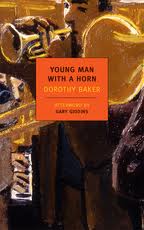
*Young Man With a Horn, by Dorothy Baker

9781590175774
NYRB Classics, 2012
originally published 1938, Houghton Mifflin
185 pp
softcover

"Music, for him, wasn't a business; it was a passion, and he was ready to give up to it."


There's a problem when readers stick to what's hot, trendy and popular in today's reading market -- they miss a lot of good older, mainly-forgotten books like this one.  Kudos to NYRB for bringing this book (and other fine novels) back to the attention of the reading public, or at least to me.

The Young Man With a Horn is Rick Martin, who, we discover as the prologue opens, is dead at a young age not long after reaching the peak of his musical genius.  Despite this, the narrator assures the reader that the story has no "grand tragic theme," but rather it is the account of a man who "had a talent for creating music as natural and fluent as -- oh, say Bach's," who would never be "put down to playing exactly what was written for him." Martin chose instead to live a life in devotion to his art; he's a man with the soul of an artist who "goes to pieces," and ultimately suffers for life's intrusions into his great passion.

The novel is divided into four books, beginning with Rick's childhood and teen years  in Los Angeles, where he meets "his first, last and always friend," Smoke Jordan. Rick Martin is a poor kid growing up in LA -- he is often truant from school; although he'd learned to read music there, school held little interest for this boy.  One day Rick wanders into the All Souls' Mission where he finds himself alone, and picks up a hymnal and starts singing the tunes (not the words -- just the music). He transfers picking out the songs in his head to the piano there, and goes back to practice until his peace is intruded upon. Although he loves the piano, he's thinking that perhaps a trumpet is more his métier. It is when he takes a job that he meets Smoke -- black to his white, and they become fast friends in a space and time where there is a racial "line that can't be crossed,"  a line Rick didn't know existed.  Smoke introduces him to the music of Jeff Williams, the bandleader at the Cotton Club -- not the Cotton Club, but the less famous one in Vernon, California south of Los Angeles.  At first the two boys would sit outside, and "let the music come to them" in the darkness of night, and it is here that  Rick's deep-seated passion music really began; the sound that he would try to recreate over the course of his short lifetime originated within the small confines of this little club whose clientele was "mostly negro with a light mixture of Mexicans and Filipinos."


 a scene of young Rick in "Young Man With a Horn," directed by Michael Curtiz, 1950

 Ultimately  taken in by this group of musicians  he considered musical geniuses and in some sense of the word, the family he never had, Rick learns how to play in earnest.  It was the rarity of the band's music, that beautiful, "pure thing put out fresh by the Cotton Club ensemble" that really grabbed hold of his soul and penetrated his psyche to the point where he came to know the band's playing style  "from the inside out."  Soon
  the fascination of making music was on him like a leech. He'd sit at the Cotton Club piano and practice until his fingernails ached from being sent the wrong way, and he'd play his trumpet until his lip crumpled up on him and shook miserably in the face of further discipline.
It takes Rick no time to realize that the tune is less important than the improvisations and the variations it inspires; even as a boy he had daydreams of the popular bandleader Paul Whiteman grooving on his talent for improvising and creating something new.  He held to this ideal even after his career started -- in Rick's mind, there was little meaning to be drawn from the dance music de jour to which the bandleaders pandered. Yet his passion and flair for improv and originality went unappreciated by his bosses who reminded him that he'd be "playing to our own kind of a crowd."   He came alive at quitting time however -- "after his good work was done, he did better work," hanging out with his friends and jamming, just playing for fun. It was in this space that he could let himself go and play for the sheer love of  music, here where he could feel that unbridled sense of being alive his music produced that little else could. Popular in his professional life, privately he "had a way of doing a thing, and ... a love of the thing so strong that he never in his life compromised it."  But when the real world intrudes, including a tempestuous marriage that further hones his drinking skills,  his drive for purity and perfection combine with his fondness for booze and eventually become the instruments of his downward slide.

Movie poster for "Young Man With a Horn," directed by Michael Curtiz, 1950

Thematically, the book touches on a number of issues: race, the question of art as opposed to commercialism;  jazz as a form of undefinable personal experience, expression and meaning; one's inner drive and the need to remain true to one's principles.

Baker writes at the outset that the inspiration for her book is "the music, but not the life, of a great musician, Leon (Bix) Beiderbecke." Rick Martin in  Young Man With a Horn is definitely not Bix Beiderbecke -- when Ken Burns' documentary Jazz re-aired a couple of years back I read Jean Pierre Lion's bio of Beiderbecke (Bix: The Definitive Biography of a Jazz Legend) and while there are a couple of similarities, Baker's book is not a borrowing of Beiderbecke's life made fiction. And I have to say that in 1938 the addition of  obviously lesbian characters was pretty gutsy.   It's also a shame that this book isn't as well known as the film that came out of it starring Kirk Douglas, Doris Day and Lauren Bacall.  It's an awesome film if you're into older movies, filled with great music if you're into old jazz,  but now that I've read the novel, it seems that the screenwriters took quite a few liberties in getting it to the big screen.

 Personally I just don't get why people don't seem very fond of this novel.  Okay, it's a bit melodramatic at the end, which comes rather quickly when maybe there might have been more buildup toward the last scene. At the same time, it's the journey through Rick Martin's short life and career in the first three books that drives this narrative as it leads up to Rick's final moments, as his love for music and his need for creative freedom take hold of him setting the stage for the direction his life will eventually take. By the time you get to the end, the final outcome should actually be of little surprise, considering the author's skill in framing Rick Martin's life up to that point. Young Man With a Horn is an appealing and compelling novel; I highly recommend it to anyone well rounded enough in their reading who can pull themselves away from the New York Times bestseller list or other currently popular novels to enjoy something from the past.