9781617751813
Akashic Books, out September 3, 2013
256 pp
Another ARC preventing me from those lovely books I have stacked on the office floor ready to read, but definitely well worth it. My thanks to LT early reviewers and to the publisher for my copy.
On
June 10, 1967, a thirty-five foot boat named "The Rambler" left the
island of Anguilla for St. Kitts carrying 16 passengers (including three
American mercenaries), a minimum of provisions, and 500 pounds of guns
and ammunition. The group was going to be part of an effort to establish
a coup to get rid of Robert L. Bradshaw, the premier of the new "state"
of St. Kitts/Nevis/Anguilla. Only his ouster, did the Anguillans
involved in the operation believe, would call international attention to
Bradshaw's neglect of Anguilla and its people. The mission failed and
failed badly, but oddly enough, the results of that day actually led the
way toward Anguilla's independence. In Night of the Rambler, a work of historical fiction, the author reimagines the
events leading up to that night and what drove a mere handful of people
to make such a gutsy move. While there are a couple of issues that
nagged at me while reading, overall, the author tells a really good
fictional story behind some real events that I never knew took place.
One
of the things that strikes me as some of the best work here is the
author's focus on his two main characters Alwyn Cooke and Rude Thompson.
While it may not be easy at first to fathom why the author seems to
jump around in time and place, he's actually setting up the backstories
of these characters, which reveal much about their present lives.
Thompson was working in Aruba during the time of the protests against
Venezuelan dictator Marcos Pérez Jiménez and learned a great deal from a
young anti-Perez-Jimenez engineer fresh from university, and also came to understand a
kind of patriotism where you "step back, see things from a distance, and
ask what can be done ..." He comes to realize that sometimes violence
might be necessary when peaceful solutions don't work. Alwyn Cooke, who
lucked out and received part of a prosperous estate as an inheritance,
loves Anguilla and its people, but unlike Thompson, hopes for a
nonviolent solution for the sake of the island's future. When they
finally come together, Cooke and Thompson are what the author calls "two
of the most important ingredients necessary for change blended into
one," and as the story progresses, he clearly reveals how these two
people with very different responses to their collective predicament
finally realize there's much more at stake than individual
personalities. Another important character, Solomon Carter, has an
interesting backstory as well: he was a sugar-cane worker in the
Dominican Republic who saw firsthand the attacks on Haitian and other
black immigrants during Trujillo's "Parsley Massacre," and saw the blood
of thousands of victims run like a river. Since then, he's sworn that
he would do everything in his power to see that nothing like that could
ever happen in Anguilla, taking a stance against the use of extreme
violence.
Another positive: the author sets the action of his
story within the context of the British-speaking Caribbean of the late
1950s through the mid-1960s, when the area was a "hotbed of
insurrections and revolts," and carefully sets out why the Anguillans
would reach the point of aiding a coup on St. Kitts. By 1966, when the
individual countries wanted internal self-governance, they first became
"associated states" of the UK, and plans for the full "statehood" for
St. Kitts/Nevis/Anguilla were in the works -- but the Anguillans wanted
no part of it. They were neglected by their nominal leader, Bradshaw of
St. Kitts, who didn't even bother to help after Hurricane Donna of 1960
decimated houses, buildings, & livestock. There was no hospital on
Anguilla, no running water, no telephone service and not even a harbor.
It was like these people were stuck there to fend for themselves -- you
can sense the Anguillans' frustration throughout the book.
What I
didn't care for so much was the narrator's interjection into a story
where he played no role except as omniscient observer -- sometimes the
smart-alecky remarks were annoying, or once he even notes that it's
"well past" his bedtime. It totally interrupts the flow and pulls the
reader right out of the historical setting. However, the story is so
good, and in the long run well told, so I can sort of overlook this
annoyance. I would most certainly recommend Night of the Rambler,
especially to people who are interested in the Caribbean islands and
their histories.
Showing posts with label book reviews - historical fiction. Show all posts
Tuesday, August 27, 2013
Monday, May 13, 2013
Harlequin's Costume, by Leonid Yuzefovich
9781782670292Glagoslav Publications, 2013
263 pp
(ARC from the publisher, thank you!)
--reposted at the crime segments
"During the performance he ruled the stage, entertained the public and ordered poor Pierrot about until, brought to the point of despair, Pierrot found an imperceptible thread in his tormenter's costume and pulled it. At that, Harlequin's costume, virtuosically sewn from rags with one single thread, fell to pieces."
Harlequin's Costume is a blend of two of my favorite genres, crime fiction and historical fiction. The time is 1871, the place St. Petersburg, Russia; Czar Alexander II is sitting on the imperial throne. It is a politically-charged time, and after the death of Austrian military attaché Prince von Ahrensburg, Chief Inspector Ivan Dmitrievich Putilin has a tough job trying to a) determine whether or not his murder is the work of some political faction and b) keep his head above water since the Czar's own secret police are also involved with their own agenda and c) maneuver around circles during a delicate time. The story is told looking back, as Putilin is working on his memoirs, "the most interesting material...accumulated over the course of my career,... something like a chronicle of crime in our Northern capital over the last thirty years." Harlequin's Costume is the first of a three-volume trilogy based on the real Ivan Putilin who served as St. Petersburg's chief of police from 1866 to 1892; in Russia his exploits are the subject of a television mini-series.
The novel is rich in period detail, and there is a definite sense of time and place that runs throughout. Considering that Yuzefovich is an historian who taught his beloved subject for some 29 years, this is not surprising. It's easy to envision not only St. Petersburg at this time, but also the multi-faceted political and diplomatic intrigue going on all around poor Putilin as he tries to suss out the truth behind the death of von Ahrensburg. The story is filled with potential suspects who have more than a few motives to want the attaché dead. As it turns out, sometimes even the slightest detail becomes important to the crime's solution. As you navigate through the streets of St. Petersburg, there are also some funny moments that lighten the intensity of Putilin's investigation. At one point Putilin's editor notes:
"Ivan Dmietrievich worked like an artist who scatters smears, blots, spots and lines on the canvas before a bewildered audience, in apparently random fashion, and then, with a flick of the wrist, suddenly pulls them together into a single whole and blinds his viewers with the instantaneous revelation of his intent, concealed hitherto in chaos."
and that is precisely the way Yuzefovich writes as well. Ivan Dmietrievich bides his time until he finds that "imperceptible thread" to unravel the investigation; Yuzefovich also waits for the perfect moment to reveal all. My only issue with this novel is that a number of times, with the switch from 1871 to later when Ivan Dmietrievich is discussing his stories with his editor, I did a quick "huh?" at the sudden changes. One moment you're reading about a shipment from Genoa with its cargo of oranges and lemons, and the next the editor is saying "somehow the freight seems out of season." These little sections would be fine (imho) in little chapters by themselves, but within the narrative it was a bit jarring to switch from one time to another so quickly.
This is definitely not a book for crime readers who want a quick solution. The story moves a bit slowly, taking you through multiple suspects and their motives, and the author takes his time to set up the political and diplomatic scene while carefully sketching out his characters. This book would probably be suited more for readers of good historical fiction (not the soap-operaish sort) or historical crime readers who want to immerse themselves in a specific time and place while their armchair detective selves try to figure out the whodunit along with the detective. I defy you to figure this one out - I certainly didn't. I hope the publishers don't wait too long before publishing the next installment -- this one was definitely right up my alley.
***
note: read from Ft. Lauderdale to Seattle -- leg one of the Hawaii trip
Friday, May 25, 2012
Trapeze, by Simon Mawer
9781590515273
Other Press, 2012
published in the UK as The Girl Who Fell From the Sky (Little, Brown)
371 pp
“Pour vivre heureux, vivons cachés”
I'm back in my historical-fiction element with Trapeze, a novel that is set in England, Scotland and France during World War II. Since reading Mawer's The Glass House, which I really liked, I've been waiting for something new from this author, and it's finally here in a story about a woman in the Special Operations Executive (SOE) , an organization created to, among other acts of espionage, help local resistance units in their efforts against the Nazis. Unlike The Glass House, Trapeze takes place over a brief span of time; like The Glass House, it will leave you thinking about this story for a long time after you've turned the last page.
Marian Sutro is a member of the Women’s Auxiliary Air Force (WAAF); as the novel opens she has been recruited by the Inter-Services Research Bureau, an organization which "trains people to work in France." Everything is hush-hush; she is not allowed to talk to anyone about what she is doing -- her parents think she's being trained as a nurse. Sent to Scotland for training, Marian goes through an intense series of courses, learning everything from parachuting and commando skills to other more covert espionage techniques designed to prepare her for the "clandestine life." All of this work is done in preparation for Marian's launch into the French countryside to aid in the resistance effort. She meets and befriends others working for the SOE, among them a young woman named Yvette who is worried she'll be booted out of the program before she can get to France, and Benoit, a young man who is very attracted to her. A most important piece of advice Marian and her fellow trainees are given comes in the form of a quotation from one of the fables of Jean-Pierre Claris de Florian: "Pour vivre heureux, vivons cachés," -- to live happily, live hidden.
Before she actually leaves for France, Marian, now "Alice," is directed to meet with some people from a different government department, one more secret than the group who originally recruited her. In addition to the duties she is to undertake for the Special Operations Executive, she is given an additional secret assignment that could help the Allies win the war if successful. The parachute mission, codenamed "Trapeze" sends her into the southwest of France as Anne-Marie Laroche, but before too long, she is ordered to Paris, which as Marian very quickly discovers, is a very dangerous place. Everyone there has the potential of being a collaborator with, or even worse, an agent of the Nazi occupation; she has arrived in a Paris that is a "city inhabited by ... ghosts of young men, ghosts of Jews, ghosts of communists and socialists," where the danger, as she puts it, is a "cancer within you, invisible, imponderable, and probably incurable.” When her first-schoolgirl love Clément Pelletier, who remained in Paris during the German occupation, discovers why she's really there, he laughingly refers to her as "The daring young girl on the flying trapeze;" a phrase not too far off the mark, as it will turn out later.
Marian starts out as a young girl who relishes the risk and the potential for actually living; as the recruiter explains, her mission has the chances of survival set about "fifty-fifty," ... "the toss of a coin:"
The novel reads like an adventure story with a bit of romance thrown in; and while it may be much less of a literary work than his Glass House, what makes this book stand out from other spy-type novels is Mawer's pacing and his prose. He slowly, step by step, ratchets up the reader's degree of interest in this character, going through her recruitment and training, lolling a bit with the love interest and the pre-mission days and into a quiet streak in rural France. But the big payoff is her time spent in Paris. These scenes are the best in the novel, where the reader is there right along with her -- and the combined suspense and unease suddenly become palpable. Combined with his wonderful writing, Mawer has produced a novel that can only be described as haunting; it becomes even more poignant as you reach the ending, because it hits you that he's based his character Marian on real women who did their parts to bring an end to the war -- all the while knowing and running the risks involved in their missions. On the negative side, I could have done without Marian getting over her Catholic guilt regarding masturbation and the sex scenes were kind of pointless. But really, those are minor niggles -- Trapeze is a fine novel, and would be of interest to anyone who reads and enjoys historical fiction.
Other Press, 2012
published in the UK as The Girl Who Fell From the Sky (Little, Brown)
371 pp
“Pour vivre heureux, vivons cachés”
I'm back in my historical-fiction element with Trapeze, a novel that is set in England, Scotland and France during World War II. Since reading Mawer's The Glass House, which I really liked, I've been waiting for something new from this author, and it's finally here in a story about a woman in the Special Operations Executive (SOE) , an organization created to, among other acts of espionage, help local resistance units in their efforts against the Nazis. Unlike The Glass House, Trapeze takes place over a brief span of time; like The Glass House, it will leave you thinking about this story for a long time after you've turned the last page.
Marian Sutro is a member of the Women’s Auxiliary Air Force (WAAF); as the novel opens she has been recruited by the Inter-Services Research Bureau, an organization which "trains people to work in France." Everything is hush-hush; she is not allowed to talk to anyone about what she is doing -- her parents think she's being trained as a nurse. Sent to Scotland for training, Marian goes through an intense series of courses, learning everything from parachuting and commando skills to other more covert espionage techniques designed to prepare her for the "clandestine life." All of this work is done in preparation for Marian's launch into the French countryside to aid in the resistance effort. She meets and befriends others working for the SOE, among them a young woman named Yvette who is worried she'll be booted out of the program before she can get to France, and Benoit, a young man who is very attracted to her. A most important piece of advice Marian and her fellow trainees are given comes in the form of a quotation from one of the fables of Jean-Pierre Claris de Florian: "Pour vivre heureux, vivons cachés," -- to live happily, live hidden.
Before she actually leaves for France, Marian, now "Alice," is directed to meet with some people from a different government department, one more secret than the group who originally recruited her. In addition to the duties she is to undertake for the Special Operations Executive, she is given an additional secret assignment that could help the Allies win the war if successful. The parachute mission, codenamed "Trapeze" sends her into the southwest of France as Anne-Marie Laroche, but before too long, she is ordered to Paris, which as Marian very quickly discovers, is a very dangerous place. Everyone there has the potential of being a collaborator with, or even worse, an agent of the Nazi occupation; she has arrived in a Paris that is a "city inhabited by ... ghosts of young men, ghosts of Jews, ghosts of communists and socialists," where the danger, as she puts it, is a "cancer within you, invisible, imponderable, and probably incurable.” When her first-schoolgirl love Clément Pelletier, who remained in Paris during the German occupation, discovers why she's really there, he laughingly refers to her as "The daring young girl on the flying trapeze;" a phrase not too far off the mark, as it will turn out later.
Marian starts out as a young girl who relishes the risk and the potential for actually living; as the recruiter explains, her mission has the chances of survival set about "fifty-fifty," ... "the toss of a coin:"
"How could she not feel fear? But it was the fear that she had felt skiing, the fear of plummeting steepness, the fear she had had when her uncle had taken her climbing, the awe-inspiring fear of space beneath her feet, a feer that teetered on the very edge of joy. She wanted to make a grand gesture, to laugh with happiness and cry Yes!, even to leap out of her chair and throw her arms around this strange man with his shrill portents of doom."In these early days, she wants to seem "extraordinary in the eyes of the anonymous passerby -- brilliant, adventurous, brave, "and in some ways there is a sense that to Marian the whole thing is a game, and there are many references to a game she played as a child with her brother and Clément called "Pig in the Middle." In one example, during a free-day hike in Scotland, she and her friend Yvette come across commandos in training, and Marian comes out of hiding yelling "Bang! Bang!...You're dead," giving herself and Yvette away. But once in France, it isn't long before she realizes that very real lives may be at stake, including her own; if she's going to play the great game and do it well, those lives depend on her having the "particular skill" to "appear to be dull and uninteresting."
The novel reads like an adventure story with a bit of romance thrown in; and while it may be much less of a literary work than his Glass House, what makes this book stand out from other spy-type novels is Mawer's pacing and his prose. He slowly, step by step, ratchets up the reader's degree of interest in this character, going through her recruitment and training, lolling a bit with the love interest and the pre-mission days and into a quiet streak in rural France. But the big payoff is her time spent in Paris. These scenes are the best in the novel, where the reader is there right along with her -- and the combined suspense and unease suddenly become palpable. Combined with his wonderful writing, Mawer has produced a novel that can only be described as haunting; it becomes even more poignant as you reach the ending, because it hits you that he's based his character Marian on real women who did their parts to bring an end to the war -- all the while knowing and running the risks involved in their missions. On the negative side, I could have done without Marian getting over her Catholic guilt regarding masturbation and the sex scenes were kind of pointless. But really, those are minor niggles -- Trapeze is a fine novel, and would be of interest to anyone who reads and enjoys historical fiction.
Saturday, May 19, 2012
Gillespie and I, by Jane Harris
9780571275168
Faber and Faber, 2011 (UK)
502 pp
(hardcover)
Exasperatingly enough, Gillespie and I is one of those books where saying too much gives away the show, a potential buzzkill for anyone who may want to read it. I bought this book last summer from the UK, having read a little about it in various threads re last year's Booker Prize speculations (and because I had enjoyed her The Observations ), but I had no idea what I was getting into once I started reading. So I'll keep quiet about what happens in this novel for anyone who may be interested in reading it. I won't even tell my real-life book friends who want to borrow it -- the lips are zipped. So here is a basic outline but I'll leave it to you to read this most superbly-crafted, delightful novel on your own. Just don't miss it, despite the 500+ pages -- it reads very quickly and hooks you from the outset.
The story is narrated by an elderly Harriet Baxter, looking back from 1933 to events in her life from 1888 through 1890. In Glascow, through a random event, she becomes friends with the family of Ned Gillespie, whom Harriet calls "a man of indisputable talent, but a man hampered by circumstance and responsibility." As a painter, Ned stood outside the privileged circle of artists
So, you may ask -- why is this scenario special? Aren't there a number of books in which the past is related through the eyes of the characters some years later? Well, it is precisely what I'm not saying that gives this book its edge, and far be it from me to spoil it. At the very beginning, in the preface, the reader is told by Harriet that she has waited quite a long time to set pen to paper, needing to put some distance between herself and a "sequence of profoundly affecting events, none the least of which was that Ned...took his own life." From that sentence on, you enter Harriet's mind, a very strange place indeed. At first you may feel like you're in some routine period piece set in Victorian Scotland, but it will not be long before you may notice an inexplicable, deep sense of unease starting to creep up on you, compelling you to keep turning pages until it's all over.
Gillespie and I is an inventive and ingenious novel, taking you quickly back into Victorian-era Scotland where you immediately become enmeshed in the characters' lives; at the same time it tends to turn your sense of perception on its head. It is very well paced, extremely readable and deliciously plotted, with equal levels of suspense and disquietude which grow as the story progresses. Jane Harris is an awesome writer, and I hope she returns with something equally as good very soon. I absolutely loved this captivating book, and I can very highly recommend it.
sidebar: I read this book on a plane from Seattle to Phoenix and then from Phoenix to Ft. Lauderdale. I hate flying, but was so caught up in this one that I forgot where I was!
Faber and Faber, 2011 (UK)
502 pp
(hardcover)
Exasperatingly enough, Gillespie and I is one of those books where saying too much gives away the show, a potential buzzkill for anyone who may want to read it. I bought this book last summer from the UK, having read a little about it in various threads re last year's Booker Prize speculations (and because I had enjoyed her The Observations ), but I had no idea what I was getting into once I started reading. So I'll keep quiet about what happens in this novel for anyone who may be interested in reading it. I won't even tell my real-life book friends who want to borrow it -- the lips are zipped. So here is a basic outline but I'll leave it to you to read this most superbly-crafted, delightful novel on your own. Just don't miss it, despite the 500+ pages -- it reads very quickly and hooks you from the outset.
The story is narrated by an elderly Harriet Baxter, looking back from 1933 to events in her life from 1888 through 1890. In Glascow, through a random event, she becomes friends with the family of Ned Gillespie, whom Harriet calls "a man of indisputable talent, but a man hampered by circumstance and responsibility." As a painter, Ned stood outside the privileged circle of artists
"notoriously prone to snobbism, and nowhere more cliquish than Scotland, wherein most established artists were possessed of wealth, an Edinburgh heritage, and a first-rate education,"many of whom were exhibiting their work at the International Exhibition. Ned is the proverbial struggling artist, with a family to support: his wife Annie (also an artist), two young daughters Sybil and Rose; the family has a small business that is managed by Ned's brother Kenneth, who has his own personal issues as well. Harriet believes in Ned as an artist and decides to do what she can to help him, going to her stepfather Ramsay (collector of inventions that don't seem to work) to help in publicizing Ned's work. He isn't so keen on the idea, but does allow Harriet money for a commissioned portrait. Harriet decides Annie should do it, and she decides to lengthen her stay in Glasgow for the purpose. Soon Harriet is a regular household fixture at the Gillespies; she plays with the two children, helps Annie around the house, talks to Ned about his art, etc. etc. She's there when the older of the two girls, Sybil, begins to exhibit bizarre behavior (painting pictures of penises on the wall, for a start) and she's also around when a terrible tragedy strikes the household. Her account of her Glasgow years are interwoven with her current life as an elderly spinster with only two little birds for companions, along with the housekeeper (who doubles as fact checker, etc., for Harriet's memoirs) Sarah.
So, you may ask -- why is this scenario special? Aren't there a number of books in which the past is related through the eyes of the characters some years later? Well, it is precisely what I'm not saying that gives this book its edge, and far be it from me to spoil it. At the very beginning, in the preface, the reader is told by Harriet that she has waited quite a long time to set pen to paper, needing to put some distance between herself and a "sequence of profoundly affecting events, none the least of which was that Ned...took his own life." From that sentence on, you enter Harriet's mind, a very strange place indeed. At first you may feel like you're in some routine period piece set in Victorian Scotland, but it will not be long before you may notice an inexplicable, deep sense of unease starting to creep up on you, compelling you to keep turning pages until it's all over.
Gillespie and I is an inventive and ingenious novel, taking you quickly back into Victorian-era Scotland where you immediately become enmeshed in the characters' lives; at the same time it tends to turn your sense of perception on its head. It is very well paced, extremely readable and deliciously plotted, with equal levels of suspense and disquietude which grow as the story progresses. Jane Harris is an awesome writer, and I hope she returns with something equally as good very soon. I absolutely loved this captivating book, and I can very highly recommend it.
sidebar: I read this book on a plane from Seattle to Phoenix and then from Phoenix to Ft. Lauderdale. I hate flying, but was so caught up in this one that I forgot where I was!
Monday, March 5, 2012
Purgatory, by Tomás Eloy Martínez
9781608197118
Bloomsbury USA, 2011
originally published as Purgatorio, 2008
translated by Frank Wynne
270 pp
(trade paper ed.)
My many thanks to the publisher for sending me this novel. Bloomsbury publishes so many fine works in translation -- keep them coming!
The author of Purgatory, Tomas Eloy Martínez, died in 2010 at the age of 75, leaving behind him an amazing legacy of fifteen books and an esteemed career in journalism. If there is anyone qualified to write about Argentina's Dirty War (1976-83) , it is Martinez. He himself went into exile after a series of reports he did for a newspaper in Buenos Aires led to blacklisting, death threats, and according to an interview conducted in 2007, armed gunmen surrounding the restaurant in which he was eating. In Purgatory, Martinez explores not only the desaparecidos, but also examines the question of those left behind when their families, friends, loved ones and neighbors just vanished. It is a sad but compelling novel, one that you won't forget long after the book is put back on its shelf. Hopefully, it may also inspire you to read other books about this dark time in Argentina's history.
The last time Emilia Cardoso saw her husband Simón was thirty years ago during a map-making assignment in a patch of desert in Argentina. She and Simon were employed as cartographers while on assignment from the Automobile Club, and they were tasked to map a desolate stretch of road outside of Tucuman. Their journey took them as far as Huacra, and it was there where Emilia's life-long purgatory began. After coming upon a group of people hiding from the military police out in the desert, some dying of thirst, they make it their own mission to offer help, and in doing so, Simón and Emilia were taken into custody themselves. Their captors separated the two and then took them away; Emilia was rescued by her father, Dr. Dupuy, who helps the military government as publisher of a magazine for influential people called La Republica. Although she searched and waited, waited and searched, she never found Simón again. He had become one of the thousands of desaparecidos, victims of Argentina's dirty war:
Oddly enough, Simón has now turned up in a New Jersey diner, where Emilia is living and working, continuing her career in maps. He hasn't aged a bit since Emilia last saw him, while she has gone on with her life, aging normally, although her life has been anything but typical.
The novel continues in alternating narratives, those of Emilia and a writer in exile who befriends her after recovering from a serious illness. He is determined to tell her story, which is related here largely through flashbacks leading back to the very beginning where her story begins, during the time of Argentina's dirty war. It was a time when reality was covered up by government propagandists, when "propaganda manufactured illusions of happiness in the wasteland of misery," and Emilia's father, Dr. Dupuy, helped make this possible, often through a smoke-and-mirrors approach to the truth. Any real truth was considered lies, the weapon of subversives who wanted to tarnish Argentina's national image and crush the national spirit. Even when information is passed on to Emilia that Simon had been killed by the military, her father told her it was the work of subversives trying to get to him and his family. But Emilia never gives up looking for Simon; she takes mapmaking jobs to support herself during her search, moves from place to place where sightings have been reported, and eventually she comes to realize that she can no longer go on this way, ultimately taking a job in New Jersey.
But all of this time Emilia has been living in her own Purgatory, " a wait whose end we cannot know." She has only one remotely close friend, she never remarries, she has trouble fitting in, she never stops hoping, never accepts that Simon might possibly be dead and lives in a constant state of denial. In this sense, Emilia has become a living ghost in a way -- as she notes after her chance meeting with Simon, "Without him, I don't exist." And this is the same fate as many of those thousands of people who had "disappeared with no apparent reason," -- indeed, as the fictional author notes,
And at the heart of this story are all of those thousands of people whose lives are on perpetual hold waiting for some word even now, decades later.
You don't need to have a background in Argentina's history to understand and appreciate this novel; it can't hurt, but Martinez manages to get the critical points of the period across to his readers without going into a lot of historical detail.
I don't suppose this book will be to everyone's taste, but if you are at all familiar with or interested in the desaparecidos or Argentina's Dirty War, you will probably really like this novel. While the blurb says "ghost story," you have to look at that phrase in terms of metaphor rather than hoping that there's something paranormal to come out of this book, so if that's what caught your eye, well, you're reading the wrong story. Purgatory is a wonderful, moving story of a woman who has been through a great deal of loss; it is also the story of the spirit of love that never dies, while at the same time , since it cannot really speak to what actually happened to the thousands of disappeared, it is the story of the ones left behind. And clever Martinez also manages to put his readers in a state of uncertainty as they wonder about Simón's return and as they wait to discover what will ultimately become of Emilia. It is a lovely book and I definitely recommend it.
Bloomsbury USA, 2011
originally published as Purgatorio, 2008
translated by Frank Wynne
270 pp
(trade paper ed.)
My many thanks to the publisher for sending me this novel. Bloomsbury publishes so many fine works in translation -- keep them coming!
The author of Purgatory, Tomas Eloy Martínez, died in 2010 at the age of 75, leaving behind him an amazing legacy of fifteen books and an esteemed career in journalism. If there is anyone qualified to write about Argentina's Dirty War (1976-83) , it is Martinez. He himself went into exile after a series of reports he did for a newspaper in Buenos Aires led to blacklisting, death threats, and according to an interview conducted in 2007, armed gunmen surrounding the restaurant in which he was eating. In Purgatory, Martinez explores not only the desaparecidos, but also examines the question of those left behind when their families, friends, loved ones and neighbors just vanished. It is a sad but compelling novel, one that you won't forget long after the book is put back on its shelf. Hopefully, it may also inspire you to read other books about this dark time in Argentina's history.
The last time Emilia Cardoso saw her husband Simón was thirty years ago during a map-making assignment in a patch of desert in Argentina. She and Simon were employed as cartographers while on assignment from the Automobile Club, and they were tasked to map a desolate stretch of road outside of Tucuman. Their journey took them as far as Huacra, and it was there where Emilia's life-long purgatory began. After coming upon a group of people hiding from the military police out in the desert, some dying of thirst, they make it their own mission to offer help, and in doing so, Simón and Emilia were taken into custody themselves. Their captors separated the two and then took them away; Emilia was rescued by her father, Dr. Dupuy, who helps the military government as publisher of a magazine for influential people called La Republica. Although she searched and waited, waited and searched, she never found Simón again. He had become one of the thousands of desaparecidos, victims of Argentina's dirty war:
"... a mystery, he has no substance, he is neither alive nor dead, he does not exist. He is a 'disappeared.' "
Oddly enough, Simón has now turned up in a New Jersey diner, where Emilia is living and working, continuing her career in maps. He hasn't aged a bit since Emilia last saw him, while she has gone on with her life, aging normally, although her life has been anything but typical.
The novel continues in alternating narratives, those of Emilia and a writer in exile who befriends her after recovering from a serious illness. He is determined to tell her story, which is related here largely through flashbacks leading back to the very beginning where her story begins, during the time of Argentina's dirty war. It was a time when reality was covered up by government propagandists, when "propaganda manufactured illusions of happiness in the wasteland of misery," and Emilia's father, Dr. Dupuy, helped make this possible, often through a smoke-and-mirrors approach to the truth. Any real truth was considered lies, the weapon of subversives who wanted to tarnish Argentina's national image and crush the national spirit. Even when information is passed on to Emilia that Simon had been killed by the military, her father told her it was the work of subversives trying to get to him and his family. But Emilia never gives up looking for Simon; she takes mapmaking jobs to support herself during her search, moves from place to place where sightings have been reported, and eventually she comes to realize that she can no longer go on this way, ultimately taking a job in New Jersey.
But all of this time Emilia has been living in her own Purgatory, " a wait whose end we cannot know." She has only one remotely close friend, she never remarries, she has trouble fitting in, she never stops hoping, never accepts that Simon might possibly be dead and lives in a constant state of denial. In this sense, Emilia has become a living ghost in a way -- as she notes after her chance meeting with Simon, "Without him, I don't exist." And this is the same fate as many of those thousands of people who had "disappeared with no apparent reason," -- indeed, as the fictional author notes,
"Emilia's not the only person to hope that someone she loves will come back from the dead; there are thousands like her, clinging to an illusion."
And at the heart of this story are all of those thousands of people whose lives are on perpetual hold waiting for some word even now, decades later.
You don't need to have a background in Argentina's history to understand and appreciate this novel; it can't hurt, but Martinez manages to get the critical points of the period across to his readers without going into a lot of historical detail.
I don't suppose this book will be to everyone's taste, but if you are at all familiar with or interested in the desaparecidos or Argentina's Dirty War, you will probably really like this novel. While the blurb says "ghost story," you have to look at that phrase in terms of metaphor rather than hoping that there's something paranormal to come out of this book, so if that's what caught your eye, well, you're reading the wrong story. Purgatory is a wonderful, moving story of a woman who has been through a great deal of loss; it is also the story of the spirit of love that never dies, while at the same time , since it cannot really speak to what actually happened to the thousands of disappeared, it is the story of the ones left behind. And clever Martinez also manages to put his readers in a state of uncertainty as they wonder about Simón's return and as they wait to discover what will ultimately become of Emilia. It is a lovely book and I definitely recommend it.
Tuesday, September 6, 2011
*Jamrach's Menagerie, by Carol Birch
9780385534406
Doubleday, 2011
295 pp.
"...the time before the dragon and the time after are not the same."
I love all things Victorian; I love Victorian novels, well-written Victorian imitations, and I just have a thing for this time period in general. Two things about this book grabbed me from the very start: first, the fact that it's set in 1857 and second, the only illustration in the book, that of a fiendish-looking waterspout on the open sea standing just behind a ship at full sail. And as it turns out, most of the way through the novel I was a very happy reader. More on this later.
Jamrach's Menagerie is Carol Birch's eleventh novel; she published her first book in 1988. It is told in the style of a Victorian narrative, although probably not as well imagined as Derby Day, which to me is a much better imitation of the style and better use of idiom. The story is related through the eyes of one Jaffy Brown, who is eight years old at the outset of the novel, and follows Jaffy through to adulthood. It is told in three parts: Jaffy's childhood and his fateful meeting with a tiger on the loose in the streets of London's East End; the events during a three-year sea voyage on which Jaffy was a crew member, and finally, Jaffy's return from the sea.
In Part One, we are introduced to Jaffy, his mother and the streets of the East End. Having been forced to move to Watney Street, one day Jaffy is out running an errand and comes upon a tiger moving down the middle of the Ratcliffe Highway. Awed by its beauty, and without fear, Jaffy lifts his hand to touch it, and is snatched up in the beast's jaws. Jaffy is fine, but the meeting with the tiger leads to a meeting with its owner, the Jamrach of the title. It is then that Jaffy's life changes -- he gets a job with Jamrach tending to his menagerie of exotic beasts. It is also then that Jaffy meets several people who will remain important in his life throughout the story. But it is how Jamrach obtains these creatures that is important to Jaffy's story, and which leads us to part two of the novel -- Jamrach arranges expeditions to capture and import the animals after a collector has decided upon his choice. As part two begins ("So much for Jaffy the child. He didn't last long, did he?"), a Mr. Fledge, "who always wanted what no one else had ever had," has decided that now he must have a dragon, an "ora". One of Jamrach's associates, a sea-faring adventurer named Dan Rymer, had related that he knew of a place where he could obtain this creature, on an island east of the Java Sea. Jaffy and his friend Tim are recruited to go on Fledge's ship the Lysander along with Rymer and the ship's whaling crew to catch and return the dragon. Promised that upon their successful return, they would never have to work again, the ship sets sail. While there is much speculation as to the nature of the dragon before the ship arrives on the island, it is finally captured (it turns out to be a komodo dragon or something along those lines) and caged on board the ship. But it isn't long until mayhem ensues and the ship is wrecked, forcing the crew to take to the whaleboats. The rest of part two is the story of the crew's adventures on the sea, reading much like the narrative of Owen Chase in The Wreck of the Whaleship Essex, also retold in Nathaniel Philbrick's In the Heart of the Sea. If you've read either of those, you will know how things come out; if not, well, you're in for something pretty gruesome. (As an aside, I can highly recommend both books). In Part Three, Jaffy returns to England (neither surprise nor spoiler since Jaffy's telling the story), where he tries to make sense of his experiences and to find his own sense of place and peace after the horrible events of the voyage of the Lysander.
This book has so many good things to offer, but there are also a few things that bothered me. Birch gives us a vivid picture of street life in London -- the mix of colors and smells, the descriptions of people at their occupations, the living conditions of the poor, the circus of people on the Ratcliffe Highway. The sense of place is well evoked; the East End comes alive. Life at sea is also well described, and through her characters, Birch manages to get across that the whaling industry is on the wane; a longstanding way of life for so many is about to end. And even here, it's like she'd been on a whaling ship herself: the scenes where the crew captures a whale and its guts are all over the decks are so real I was kind of gagging just picturing it. Later there are some pretty tense moments during the capture of the dragon on the island and on board the ship, but surprisingly, even though what comes afterwards in the whaleboats will both haunt and come to define Jaffy's post-Lysander life, the telling of these events comes across as rather flat. And even more surprisingly, other than the group of three main characters Tim, Rymer and Jaffy, I didn't find the rest of them to be as well developed, always staying on the periphery of becoming real people to which readers could relate, maybe with the exception of Skip.
Other than those issues with the novel, I actually ended up liking Jamrach's Menagerie -- it may have been a bit on the shallow side at times but overall it was one of those books you want to call a "rollicking good yarn." Seen in that context, it was a pretty good read.
Doubleday, 2011
295 pp.
"...the time before the dragon and the time after are not the same."
I love all things Victorian; I love Victorian novels, well-written Victorian imitations, and I just have a thing for this time period in general. Two things about this book grabbed me from the very start: first, the fact that it's set in 1857 and second, the only illustration in the book, that of a fiendish-looking waterspout on the open sea standing just behind a ship at full sail. And as it turns out, most of the way through the novel I was a very happy reader. More on this later.
Jamrach's Menagerie is Carol Birch's eleventh novel; she published her first book in 1988. It is told in the style of a Victorian narrative, although probably not as well imagined as Derby Day, which to me is a much better imitation of the style and better use of idiom. The story is related through the eyes of one Jaffy Brown, who is eight years old at the outset of the novel, and follows Jaffy through to adulthood. It is told in three parts: Jaffy's childhood and his fateful meeting with a tiger on the loose in the streets of London's East End; the events during a three-year sea voyage on which Jaffy was a crew member, and finally, Jaffy's return from the sea.
In Part One, we are introduced to Jaffy, his mother and the streets of the East End. Having been forced to move to Watney Street, one day Jaffy is out running an errand and comes upon a tiger moving down the middle of the Ratcliffe Highway. Awed by its beauty, and without fear, Jaffy lifts his hand to touch it, and is snatched up in the beast's jaws. Jaffy is fine, but the meeting with the tiger leads to a meeting with its owner, the Jamrach of the title. It is then that Jaffy's life changes -- he gets a job with Jamrach tending to his menagerie of exotic beasts. It is also then that Jaffy meets several people who will remain important in his life throughout the story. But it is how Jamrach obtains these creatures that is important to Jaffy's story, and which leads us to part two of the novel -- Jamrach arranges expeditions to capture and import the animals after a collector has decided upon his choice. As part two begins ("So much for Jaffy the child. He didn't last long, did he?"), a Mr. Fledge, "who always wanted what no one else had ever had," has decided that now he must have a dragon, an "ora". One of Jamrach's associates, a sea-faring adventurer named Dan Rymer, had related that he knew of a place where he could obtain this creature, on an island east of the Java Sea. Jaffy and his friend Tim are recruited to go on Fledge's ship the Lysander along with Rymer and the ship's whaling crew to catch and return the dragon. Promised that upon their successful return, they would never have to work again, the ship sets sail. While there is much speculation as to the nature of the dragon before the ship arrives on the island, it is finally captured (it turns out to be a komodo dragon or something along those lines) and caged on board the ship. But it isn't long until mayhem ensues and the ship is wrecked, forcing the crew to take to the whaleboats. The rest of part two is the story of the crew's adventures on the sea, reading much like the narrative of Owen Chase in The Wreck of the Whaleship Essex, also retold in Nathaniel Philbrick's In the Heart of the Sea. If you've read either of those, you will know how things come out; if not, well, you're in for something pretty gruesome. (As an aside, I can highly recommend both books). In Part Three, Jaffy returns to England (neither surprise nor spoiler since Jaffy's telling the story), where he tries to make sense of his experiences and to find his own sense of place and peace after the horrible events of the voyage of the Lysander.
This book has so many good things to offer, but there are also a few things that bothered me. Birch gives us a vivid picture of street life in London -- the mix of colors and smells, the descriptions of people at their occupations, the living conditions of the poor, the circus of people on the Ratcliffe Highway. The sense of place is well evoked; the East End comes alive. Life at sea is also well described, and through her characters, Birch manages to get across that the whaling industry is on the wane; a longstanding way of life for so many is about to end. And even here, it's like she'd been on a whaling ship herself: the scenes where the crew captures a whale and its guts are all over the decks are so real I was kind of gagging just picturing it. Later there are some pretty tense moments during the capture of the dragon on the island and on board the ship, but surprisingly, even though what comes afterwards in the whaleboats will both haunt and come to define Jaffy's post-Lysander life, the telling of these events comes across as rather flat. And even more surprisingly, other than the group of three main characters Tim, Rymer and Jaffy, I didn't find the rest of them to be as well developed, always staying on the periphery of becoming real people to which readers could relate, maybe with the exception of Skip.
Other than those issues with the novel, I actually ended up liking Jamrach's Menagerie -- it may have been a bit on the shallow side at times but overall it was one of those books you want to call a "rollicking good yarn." Seen in that context, it was a pretty good read.
Monday, August 22, 2011
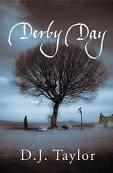
*Derby Day, by DJ Taylor
9780701183585
Chatto and Windus, 2011
405 pp
Derby Day "...gives all London an airing , an 'outing,' makes a break in our overworked lives and effects a beneficial commingling of the classes."
-- Gustave Doré and Blanchard Jerrold ("The Derby", in London: A Pilgrimage, 1872)
Doré and Jerrold made their observations about the annual Derby happening at Epsom, but they are also describing DJ Taylor's newest novel. Like his book Kept (which I read some time ago and really enjoyed), Derby Day is subtitled "A Victorian Mystery," and there is enough intrigue and foul play scattered throughout the novel's 400+ pages to keep a mystery reader happy. At the same time, it's a novel that brings together several characters from different walks of life in Victorian England, many of whose fortunes hang in the balance based on the performance of a race horse named Tiberius. Derby Day does indeed offer its readers a "break" in their "overworked lives": although his Victorian narrative style may not be everyone's cup of tea, the story is a great deal of fun. And I would have bought this book even if it had not appeared on this year's longlist, because of my previous enjoyment of Taylor's Kept.
In Lincolnshire, Samuel Davenant is the owner of a horse named Tiberius, who had
The action is not as cut and dried as one would think and there are a number of surprises that unfold as the novel progresses, keeping things moving with rarely a dull moment in the story. The sense of place is vividly evoked as the reader travels through the fens and wild landscape of Lincolnshire (where it "would not have been strange to peep between the fence posts and see Lady Dedlock out a-wandering"), as well as through the upper-class London neighborhoods and their counterparts in the seamier sides of the city. And Epsom, just before and during the Derby, comes alive with its sights, smells, noise and carnival-like atmosphere, all beautifully imagined by the author. Subplots abound as in any good Victorian drama, and the ever-expanding cast of characters presents a range of personalities: the cream of London society, a young governess in the bleak Lincolnshire countryside, an enigmatic jewel thief whose past is his major preoccupation, a disgraced army officer who frequents the billiard halls (a nod to Thackeray's "English Raff," from his Book of Snobs,) an older jockey on the portly side and the crowds who attend the Derby, to name a few. Twists of fate and "odd conjunctions" bring these people together from time to time, making for great dynamic among the characters, but most especially between Happerton and his wife. While Mrs. Carmody's Book of Genteel Behavior of 1861 offers the Victorian woman tips about married life and one's place in society, Mrs. Happerton turns Mrs. Carmody's advice on its head, to the point where the reader begins to doubt who really has the upper hand in that relationship.
Derby Day is one of those books that will appeal to a wide variety of readers -- it is filled with plotting and machinations that will satisfy readers of melodrama and mystery, it offers an intriguing portrait of a slice of time for historical fiction readers, and its constant nod to Thackeray throughout the novel will make Victorian fiction readers happy as well. If I have any complaints, they are minor -- the amount of subplots is a bit dizzying at times, as are the number of new characters that appear here and there that tended to distract my reading flow. Otherwise, Derby Day is highly entertaining, and I can definitely recommend it.
Chatto and Windus, 2011
405 pp
Derby Day "...gives all London an airing , an 'outing,' makes a break in our overworked lives and effects a beneficial commingling of the classes."
-- Gustave Doré and Blanchard Jerrold ("The Derby", in London: A Pilgrimage, 1872)
Doré and Jerrold made their observations about the annual Derby happening at Epsom, but they are also describing DJ Taylor's newest novel. Like his book Kept (which I read some time ago and really enjoyed), Derby Day is subtitled "A Victorian Mystery," and there is enough intrigue and foul play scattered throughout the novel's 400+ pages to keep a mystery reader happy. At the same time, it's a novel that brings together several characters from different walks of life in Victorian England, many of whose fortunes hang in the balance based on the performance of a race horse named Tiberius. Derby Day does indeed offer its readers a "break" in their "overworked lives": although his Victorian narrative style may not be everyone's cup of tea, the story is a great deal of fun. And I would have bought this book even if it had not appeared on this year's longlist, because of my previous enjoyment of Taylor's Kept.
In Lincolnshire, Samuel Davenant is the owner of a horse named Tiberius, who had
"won the Epsom's Two Year's Old Plate, altogether ran away with the Trial Stakes at Abingdon and absolutely tied with the Duke of Grafton's Creditor for the Middle Park Plate."Although the horse has great potential in the upcoming Derby, Davenant is deeply in debt, scarcely able to feed it. After the disappointing purchase of two other horses on the back of Tiberius' reputation ("thinking that where one animal had gone others might follow"), and an unsuccessful lawsuit against a neighbor, Davenant has mounting bills that he cannot pay. He's a quiet man, preferring the solitude of his home, Scroop Hall, where he lives with his daughter Evie. At the same time, in London, Mr. Happerton is a rakish young man who is fascinated with Tiberius, noting that "There are men who would pay five thousand to have him running under their name." Happerton knows Davenant's financial situation and has been quietly buying up his debts, secretly planning to take Tiberius when the bills come due and Davenant is forcibly pushed into bankruptcy. The problem is that his scheme requires an outlay of capital which Happerton doesn't have. To remedy that situation, Happerton marries Rebecca Gresham, daughter of a well-to-do lawyer. But while his father-in-law's money isn't enough to fully finance his plans, Happerton's not too worried: he is a man ready with a few more tricks up his sleeve.
The action is not as cut and dried as one would think and there are a number of surprises that unfold as the novel progresses, keeping things moving with rarely a dull moment in the story. The sense of place is vividly evoked as the reader travels through the fens and wild landscape of Lincolnshire (where it "would not have been strange to peep between the fence posts and see Lady Dedlock out a-wandering"), as well as through the upper-class London neighborhoods and their counterparts in the seamier sides of the city. And Epsom, just before and during the Derby, comes alive with its sights, smells, noise and carnival-like atmosphere, all beautifully imagined by the author. Subplots abound as in any good Victorian drama, and the ever-expanding cast of characters presents a range of personalities: the cream of London society, a young governess in the bleak Lincolnshire countryside, an enigmatic jewel thief whose past is his major preoccupation, a disgraced army officer who frequents the billiard halls (a nod to Thackeray's "English Raff," from his Book of Snobs,) an older jockey on the portly side and the crowds who attend the Derby, to name a few. Twists of fate and "odd conjunctions" bring these people together from time to time, making for great dynamic among the characters, but most especially between Happerton and his wife. While Mrs. Carmody's Book of Genteel Behavior of 1861 offers the Victorian woman tips about married life and one's place in society, Mrs. Happerton turns Mrs. Carmody's advice on its head, to the point where the reader begins to doubt who really has the upper hand in that relationship.
Derby Day is one of those books that will appeal to a wide variety of readers -- it is filled with plotting and machinations that will satisfy readers of melodrama and mystery, it offers an intriguing portrait of a slice of time for historical fiction readers, and its constant nod to Thackeray throughout the novel will make Victorian fiction readers happy as well. If I have any complaints, they are minor -- the amount of subplots is a bit dizzying at times, as are the number of new characters that appear here and there that tended to distract my reading flow. Otherwise, Derby Day is highly entertaining, and I can definitely recommend it.
Monday, May 2, 2011
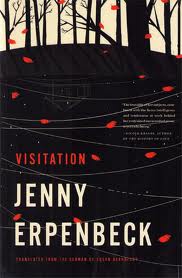
Visitation, by Jenny Erpenbeck
9780811218351
New Directions Publishing
2010
Originally published as Heimsuchung, 2008
translated by Susan Bernofsky
Opening with the above epigraphs, Visitation is a rather stunning, although very short, novel of historical fiction that offers the stories of the inhabitants of a lakefront summer house in the woods of Brandenburg through the movement of time and history in Germany. The prologue opens twenty-four thousand years ago with an advancing glacier, then progresses geologically over the years until the Brandenburg lakes began to form. As the land comes to be settled, it too follows a natural progression -- it is parceled off and sold, a beautiful home is built, land is added, subtracted, reparceled, etc. The slow and natural progression of the landscape stands in stark contrast to the rapid events that play out throughout Germany and all of its accompanying turmoil as decades pass, but at the same time, what ultimately happens to this land and to the house mirrors what happens in this country during the twentieth century.
It is on one of these lakes that a wealthy farmer owns a large tract of land, and his daughters are each slated to receive their own parcels as their respective inheritances. But the farmer sells off parts of the land designated for his daughter Klara in three parts, to a coffee and tea importer, a Jewish manufacturer of fine cloth and an architect from Berlin, who is the builder of a fine house of “quality German workmanship.” The rise of the Nazis and the second world war result in changes of occupancy and ownership once again, and the home is requisitioned by the Russian Army as the soldiers come into Germany to liberate the country. As the powers that be begin to contemplate and to build the Berlin wall, the land and the home begin another round of inhabitants under the collectivization policies of the government of the GDR (East Germany). The fall of the wall and its aftermath also bring about their own changes. Through the entire story, the house and the land undergo a series of transformations, and the only thing that remains constant is the character of "The Gardener," a somewhat mysterious and symbolic figure whose story of the work he does on the land is related after each chapter. The author offers brief but very powerful glimpses into the stories of the residents as they move in and lay down a foundation of memories and histories. Happy times spent there also serve as a safe haven and an anchor for some characters in times far removed from their carefree days on the lake. Through it all people live out their private lives in the house and on its grounds, often in contrast to the very public upheavals that have occurred in a century of Germany's history.
This novel is highly reminiscent of Simon Mawer's excellent novel The Glass Room, where the author brought the events of twentieth-century European history to a particular house. But Visitation is vastly different -- where Mawer's book set forth the events of history chronologically in a traditional narrative style, Visitation isn't what most readers would consider a "conventional" novel. It's based more on differing personal perspectives rather than a straightforward chronicle of events. Within each chapter, people and events often float back and forth in time with no warning, and it can be a little disconcerting until you feel like you have more of a bigger picture. Erpenbeck writes her chapters in long paragraphs, so that a single event and connected thoughts are covered, generally relating back to the opening of the chapter so that events can shift or things can get a bit tangential before the chapter circles back and is over. There are times when the prose seems to transform from narrative to melody, as the author often repeats certain lines like refrains from a poem or song. And just as the style becomes comfortable, the author gives the reader a jolt. There are a couple of times where this happens -- first in a heartbreaking chapter from the perspective of a little girl in the Warsaw Ghetto (the only chapter that takes place away from the house), and second in a most disturbing chapter from the point of view of a Russian army officer. There are a few parts of the book that may seem tedious -- pieces of folklore, official documents, minor details about the house and grounds etc., but these things genuinely fit into and enhance the story and should not be glossed over. The characters have their own personas and voices, each with his or her own story, thoughts and feelings, all most excellently captured by the translator, and you cannot help but get caught up in these lives.
It's a beautiful book, and all of the things that make it less than conventional -- plus Erpenbeck's focus on the landscape (if even briefly) "coming to resemble itself once more" despite all of the tumult in our private lives and the world in which we live -- are what appealed to me as a reader. It's a challenging book, but if your focus is on the bigger picture rather than a chapter here and there, it's ultimately a rewarding reading experience.
New Directions Publishing
2010
Originally published as Heimsuchung, 2008
translated by Susan Bernofsky
"As the day is long and the world is old, many people can stand in the same place, one after the other." -- Georg Büchner
"If I came to you,
O woods of my youth, could you
Promise me peace once again?" -- Friedrich Holderlin
"When the house is finished, Death enters." -- Arabic proverb
"If I came to you,
O woods of my youth, could you
Promise me peace once again?" -- Friedrich Holderlin
"When the house is finished, Death enters." -- Arabic proverb
Opening with the above epigraphs, Visitation is a rather stunning, although very short, novel of historical fiction that offers the stories of the inhabitants of a lakefront summer house in the woods of Brandenburg through the movement of time and history in Germany. The prologue opens twenty-four thousand years ago with an advancing glacier, then progresses geologically over the years until the Brandenburg lakes began to form. As the land comes to be settled, it too follows a natural progression -- it is parceled off and sold, a beautiful home is built, land is added, subtracted, reparceled, etc. The slow and natural progression of the landscape stands in stark contrast to the rapid events that play out throughout Germany and all of its accompanying turmoil as decades pass, but at the same time, what ultimately happens to this land and to the house mirrors what happens in this country during the twentieth century.
It is on one of these lakes that a wealthy farmer owns a large tract of land, and his daughters are each slated to receive their own parcels as their respective inheritances. But the farmer sells off parts of the land designated for his daughter Klara in three parts, to a coffee and tea importer, a Jewish manufacturer of fine cloth and an architect from Berlin, who is the builder of a fine house of “quality German workmanship.” The rise of the Nazis and the second world war result in changes of occupancy and ownership once again, and the home is requisitioned by the Russian Army as the soldiers come into Germany to liberate the country. As the powers that be begin to contemplate and to build the Berlin wall, the land and the home begin another round of inhabitants under the collectivization policies of the government of the GDR (East Germany). The fall of the wall and its aftermath also bring about their own changes. Through the entire story, the house and the land undergo a series of transformations, and the only thing that remains constant is the character of "The Gardener," a somewhat mysterious and symbolic figure whose story of the work he does on the land is related after each chapter. The author offers brief but very powerful glimpses into the stories of the residents as they move in and lay down a foundation of memories and histories. Happy times spent there also serve as a safe haven and an anchor for some characters in times far removed from their carefree days on the lake. Through it all people live out their private lives in the house and on its grounds, often in contrast to the very public upheavals that have occurred in a century of Germany's history.
This novel is highly reminiscent of Simon Mawer's excellent novel The Glass Room, where the author brought the events of twentieth-century European history to a particular house. But Visitation is vastly different -- where Mawer's book set forth the events of history chronologically in a traditional narrative style, Visitation isn't what most readers would consider a "conventional" novel. It's based more on differing personal perspectives rather than a straightforward chronicle of events. Within each chapter, people and events often float back and forth in time with no warning, and it can be a little disconcerting until you feel like you have more of a bigger picture. Erpenbeck writes her chapters in long paragraphs, so that a single event and connected thoughts are covered, generally relating back to the opening of the chapter so that events can shift or things can get a bit tangential before the chapter circles back and is over. There are times when the prose seems to transform from narrative to melody, as the author often repeats certain lines like refrains from a poem or song. And just as the style becomes comfortable, the author gives the reader a jolt. There are a couple of times where this happens -- first in a heartbreaking chapter from the perspective of a little girl in the Warsaw Ghetto (the only chapter that takes place away from the house), and second in a most disturbing chapter from the point of view of a Russian army officer. There are a few parts of the book that may seem tedious -- pieces of folklore, official documents, minor details about the house and grounds etc., but these things genuinely fit into and enhance the story and should not be glossed over. The characters have their own personas and voices, each with his or her own story, thoughts and feelings, all most excellently captured by the translator, and you cannot help but get caught up in these lives.
It's a beautiful book, and all of the things that make it less than conventional -- plus Erpenbeck's focus on the landscape (if even briefly) "coming to resemble itself once more" despite all of the tumult in our private lives and the world in which we live -- are what appealed to me as a reader. It's a challenging book, but if your focus is on the bigger picture rather than a chapter here and there, it's ultimately a rewarding reading experience.
fiction from Germany
Thursday, February 17, 2011
*The Vagrants, by Li Yiyun
9780812973341
Random House
349 pp
Trade Paper edition - 2010; originally published 2009
The Vagrants is Li Yiyun's first novel, set in the People's Republic of China in 1979 in a provincial town called Muddy River. China's Cultural Revolution is over and Mao has been dead for three years. Most of the action takes place between two executions -- the first that of Gu Shan. When she was fourteen, she had been a "fanatic believer in Chairman Mao and his cultural revolution," but then changed her mind as she got older, becoming an "adamant nonbeliever and a harsh critic of her generation's revolutionary zeal." She made the mistake of putting her doubts into a letter she wrote to her boyfriend, who turned her in to the authorities. For his action, he was allowed to join the army; she was put into prison, and eventually executed. But before her death, the townspeople turn out for her denunciation ceremony -- a circus-like atmosphere in which songs are sung, speeches are made and people, including schoolchildren, are shouting revolutionary slogans. The story goes on with the execution's aftermath and its effects on several people, including her mother and father and others in the town. It's a story about betrayals -- official ones like the one that sent Gu Shan to prison and the other, more personal ones people face in life, and a story about the uncertainties of living in a country where things change rapidly, creating uncertainty in the lives of the people.
There are several characters through whom the story passes, and rather than leave the story in the hands of one or two of these people, the author presents her story through a more omniscient viewpoint. Gu Shan's execution is a jumping-off point for the novel, and since the author gave her no voice of her own, her story is told through the eyes of others in little bits and pieces to be collected by the reader. Somewhere in their stories the real Gu Shan exists. These people range from the powerful to the poor, but all are looking for something more permanent in a situation where the political landscape that seems to be always changing, so that no one knows what the next day might bring. Not everyone sees things in terms of politics here; some people are just trying to survive, while others do their best after personal disappointments to get by; but inevitably, the truth is that no one is immune to the whims of the government, especially during this time period, when there's a great deal of political upheaval going on throughout the country. Not even the political higher-ups of the town are immune from the changing winds of Beijing:
The most interesting character in the novel is Teacher Gu, father of Shan, a rather confused and fatalistic sort of man who lives in a world largely defined through his nostalgia for times past, and whose advice has always been to stay small and remain unnoticed, even while events around him seem to spiral out of control.
The Vagrants is one of those books that has a lot of rave reviews but truthfully I didn't love it. It's not because of the subject matter; there are many books that describe different historical periods of the People's Republic in much more harrowing detail. Less characters and more of a focus might have tightened up this novel to make it flow better. It reads like a series of vignettes where the story drops off to be picked up later, and there are a number of diversions (such as with the characters Nini and Bashi) that often give the story more of a rambling quality. I understand that the author is trying to give the story more of a collective viewpoint, but it was a bit grating at times to be in the middle of a storyline and then have things shift.
I'd recommend this book to readers who are interested in historical fiction and who like books from authors like Lisa See. Li is a talented author, but if you want something more serious, there are several authors that write more intensely about the People's Republic -- I'd suggest authors more along the lines of Yu Hua, Su Tong, Yan Lianke or Bi Feiyu.
Random House
349 pp
Trade Paper edition - 2010; originally published 2009
The Vagrants is Li Yiyun's first novel, set in the People's Republic of China in 1979 in a provincial town called Muddy River. China's Cultural Revolution is over and Mao has been dead for three years. Most of the action takes place between two executions -- the first that of Gu Shan. When she was fourteen, she had been a "fanatic believer in Chairman Mao and his cultural revolution," but then changed her mind as she got older, becoming an "adamant nonbeliever and a harsh critic of her generation's revolutionary zeal." She made the mistake of putting her doubts into a letter she wrote to her boyfriend, who turned her in to the authorities. For his action, he was allowed to join the army; she was put into prison, and eventually executed. But before her death, the townspeople turn out for her denunciation ceremony -- a circus-like atmosphere in which songs are sung, speeches are made and people, including schoolchildren, are shouting revolutionary slogans. The story goes on with the execution's aftermath and its effects on several people, including her mother and father and others in the town. It's a story about betrayals -- official ones like the one that sent Gu Shan to prison and the other, more personal ones people face in life, and a story about the uncertainties of living in a country where things change rapidly, creating uncertainty in the lives of the people.
There are several characters through whom the story passes, and rather than leave the story in the hands of one or two of these people, the author presents her story through a more omniscient viewpoint. Gu Shan's execution is a jumping-off point for the novel, and since the author gave her no voice of her own, her story is told through the eyes of others in little bits and pieces to be collected by the reader. Somewhere in their stories the real Gu Shan exists. These people range from the powerful to the poor, but all are looking for something more permanent in a situation where the political landscape that seems to be always changing, so that no one knows what the next day might bring. Not everyone sees things in terms of politics here; some people are just trying to survive, while others do their best after personal disappointments to get by; but inevitably, the truth is that no one is immune to the whims of the government, especially during this time period, when there's a great deal of political upheaval going on throughout the country. Not even the political higher-ups of the town are immune from the changing winds of Beijing:
There were clearly two camps, both with significant representation in the central government and among party leaders. Were the leaflets in Muddy River the spawn of the democratic wall seven hundred miles away? And what should they do, which side should they take? -- the questions puzzled those people who had never worried over the lack of a meal, a bed or a job. Offices became minefields where one had to watch out for oneself, constantly defining and redefining friends, enemies, and chameleons who could morph from friends to enemies and then back again. With their fates and their families' futures in their hands, these people sleepwalked by day and shuddered by night.
The most interesting character in the novel is Teacher Gu, father of Shan, a rather confused and fatalistic sort of man who lives in a world largely defined through his nostalgia for times past, and whose advice has always been to stay small and remain unnoticed, even while events around him seem to spiral out of control.
The Vagrants is one of those books that has a lot of rave reviews but truthfully I didn't love it. It's not because of the subject matter; there are many books that describe different historical periods of the People's Republic in much more harrowing detail. Less characters and more of a focus might have tightened up this novel to make it flow better. It reads like a series of vignettes where the story drops off to be picked up later, and there are a number of diversions (such as with the characters Nini and Bashi) that often give the story more of a rambling quality. I understand that the author is trying to give the story more of a collective viewpoint, but it was a bit grating at times to be in the middle of a storyline and then have things shift.
I'd recommend this book to readers who are interested in historical fiction and who like books from authors like Lisa See. Li is a talented author, but if you want something more serious, there are several authors that write more intensely about the People's Republic -- I'd suggest authors more along the lines of Yu Hua, Su Tong, Yan Lianke or Bi Feiyu.
Thursday, February 10, 2011
Lumen, by Ben Pastor
9781940738664
Bitter Lemon Press
2011
Originally published 1999
313 pp.
Lumen is a novel of crime fiction; at the same time it's a solid piece of historical fiction that takes place in 1939 just after the invasion and occupation of Poland by the Nazis. You can read about it over at the Crime Segments portion of my reading journal. If you want to read a well-written book of historical fiction, you might wish to give this one a try.
Bitter Lemon Press
2011
Originally published 1999
313 pp.
Lumen is a novel of crime fiction; at the same time it's a solid piece of historical fiction that takes place in 1939 just after the invasion and occupation of Poland by the Nazis. You can read about it over at the Crime Segments portion of my reading journal. If you want to read a well-written book of historical fiction, you might wish to give this one a try.
Monday, September 20, 2010
The Long Song, by Andrea Levy
9780374192174
Well, here's a lesson for me. When I first saw that this book had made the Booker Prize longlist, I was thrilled. I had read the author's Small Island when it first came out some years back and liked it so I was eager to get into this one. Then, when I picked it up and started reading it, I was a bit unsure, because my first thought was "oh no, another book about slavery." There's a story behind that remark: about a year ago, I had read a book about slavery that was emotionally difficult to get through called The Book of Night Women, by Marcus James and frankly, I didn't think I could go there again. But The Long Song was not at all what I was expecting -- and I ended up being unable to put it down. And while I didn't love it, I liked it very much.
The narrator is Miss July, who was a slave at Amity plantation in Jamaica in the 19th century, as well as a witness to the end of slavery. At first she's extremely reluctant and even apologetic in describing the night she was conceived, but eventually, her son, who is publishing his mother's memoirs, notes that this didn't last long:
The author does not disguise any of the dehumanizing and horrifying aspects of slavery, or the racism inherent among the whites who do not see slaves as people but rather as chattel. She also examines the color line among the slaves themselves in July's discussion about Miss Clara, famous for her white man's boarding house, her dances (to which July would never be invited) and her jams:
I can definitely recommend this book -- it is powerful, extremely well written and it's a story you won't soon forget.
Frances Coady/Farrar, Straus and Giroux
2010
313 pp.
Well, here's a lesson for me. When I first saw that this book had made the Booker Prize longlist, I was thrilled. I had read the author's Small Island when it first came out some years back and liked it so I was eager to get into this one. Then, when I picked it up and started reading it, I was a bit unsure, because my first thought was "oh no, another book about slavery." There's a story behind that remark: about a year ago, I had read a book about slavery that was emotionally difficult to get through called The Book of Night Women, by Marcus James and frankly, I didn't think I could go there again. But The Long Song was not at all what I was expecting -- and I ended up being unable to put it down. And while I didn't love it, I liked it very much.
The narrator is Miss July, who was a slave at Amity plantation in Jamaica in the 19th century, as well as a witness to the end of slavery. At first she's extremely reluctant and even apologetic in describing the night she was conceived, but eventually, her son, who is publishing his mother's memoirs, notes that this didn't last long:
Although shy of the task at first, after several months she soon became quite puffed up, emboldened to the point where my advice often fell on to ears that remained deaf to it.And really, July holds nothing back; indeed sometimes her zeal leads her to fabricate, but manages to rein in the "nice" version of her stories to get back to the reality of her life in Jamaica. She belongs to John Howarth, master of Amity, and works out in the fields until the arrival of Howarth's sister, Caroline Mortimer. Caroline brought a maid with her from England, but the maid dies shortly thereafter, and Caroline decides to take July in her maid's place. Inside the house, the mischievous and often devilish July is given the name "Marguerite," and with the other house servants, does everything she can to thwart Caroline, including putting a soiled bedsheet on the table instead of the best tablecloth for a company dinner. Her time at Amity runs through The Baptist War or Christmas Uprising of 1831, as well as through the eventual emancipation of all of the slaves in 1838. In the meantime, a string of overseers come to Amity, ending with Robert Goodwin, whose arrival changes everything about life at the plantation.
The author does not disguise any of the dehumanizing and horrifying aspects of slavery, or the racism inherent among the whites who do not see slaves as people but rather as chattel. She also examines the color line among the slaves themselves in July's discussion about Miss Clara, famous for her white man's boarding house, her dances (to which July would never be invited) and her jams:
Only with a white man, can there be guarantee that the colour of your pickney will be raised. For a mulatto who breeds with a white man will bring forth a quadroon; and the quadroon that enjoys white relations will give to this world a mustee; the mustee will beget a mustiphino; and the mustiphino...oh, the mustaphino's child with a white man for a papa will find each day greets them no longer with a frown, but welcomes them with a smile, as they at last stride within this world as a cherished white person....Forward only to white skin became Miss Clara's mission.Her characterizations are very real, from the slaves to the masters to well-meaning Christian ministers and sympathetic white people. Her sense of place is well evoked. And even small details become meaningful, especially in one of my favorite parts of the novel: a story about a painting by the artist Francis Bear. But what really shines through here is the emphasis on the power of storytelling, which is highlighted each time July gives an introduction to what she's writing, addressing herself often as "your storyteller," and even advising her readers that she can't go on, interjecting herself throughout the story:
I can go no further! Reader, my story is at an end. Close up this book and go on about your day. You have heard all that I have to tell of a life lived upon this sugar island. This wretched pen will blot and splutter with ink no more in pursuance of our character July. I now lay it down in its final rest.But thankfully, she does go on, until her "long song" is finished. I appreciated the fact that Ms. Levy might have chosen to bring a sappy ending to this story that might have diminished this novel and did not, thereby maintaining the integrity of The Long Song until the final word.
I can definitely recommend this book -- it is powerful, extremely well written and it's a story you won't soon forget.
Sunday, May 16, 2010
The Informer, by Craig Nova
9780307236937
Shaye Areheart Books
2010 A few posts ago I commented on the general lack of respect on the part of people who will go to a bookstore, order a coffee & a chocolate chip cookie and then proceed to leave evidence of their presence on the pages of a brand new book. As noted, I had the misfortune of discovering this nasty habit while at my local B&N, when I went to buy a copy of The Informer, by Craig Nova. If you don't want to go back & read the post, the long and short of it is that there was only one copy available in the store, and not only were there chocolate fingerprints on it, but the first page had been torn as well making it totally unbuyable. Aaargh. Shortly after I made that post, a knight in shining armor in the form of Mr. Stephen Will, a publicist at The Hendra Agency, took pity on my plight and offered me a copy. So...to Mr. Stephen Will I offer my most hearty thanks.
I liked this book -- it appeals to the part of me that loves intelligence in the written word. As a work of historical fiction, it is very well written.
The Informer is set in Berlin at the end of Germany's Weimar Republic (1918-1933) and Germany's politics are fractured among the lines of three main political groups: the Communists, the various right-wing groups (including but not limited to the Nazis), and the prevailing Socialist government. On the streets these divisions often play out as brawls and skirmishes between rival factions, each with its gang of thugs, and this fracture continues on up into city and governmental bureaucracies where thuggery is more or less official yet clandestine. Everything is played according to where one's loyalties lie.
Without going into the plot, at the center of this well-written novel is Gaelle, the disfigured 22 year old prostitute and "The Informer" of the story. Gaelle is protected as well as pimped out by Felix, a 16 year old boy who lives on the streets with his ears to the ground. She often supplements their earnings by selling secrets she learns from clients, which works well for the two of them until she happens upon some intelligence regarding a man who works at the Soviet Embassy and spies on the Red Front for the Brownshirts. While all of this is happening, Armina Treffen, a police officer in Inspectorate A (a division of the kriminalpolizei that investigates homicide), is seeking a serial killer who is stalking young women in the Tiergarten park area. Armina is a professional and cares about her work, but she has her own personal issues which are compounded by the politics of her boss Ritter, which hamper her work on the case.
The Informer is not your average "Berlin noir" type of novel like Jonathan Rabb's series (beginning with Rosa), nor is it like Kerr's Berlin novels, both of which are both more plot driven. It is more character driven, with its atmosphere of place and time acting as the headliner. From the very beginning, the book draws you into the "malice" (the author's word) pervading the streets and the very air, not to mention the uncertainty of what is to come. In this sense, the suspense aspect of the novel permeates throughout -- not so much as an aspect of the novel's plotline, but in terms of the future of the German people. There are several scenes in which the author offers a brief foreshadowing of the future -- a line of people at the local vet having their dogs killed as a solution to their inability to feed their pets because of the high rate of inflation, and the description of Armina going daily by the children from the "special" school -- both send a shiver up the reader's spine because we know exactly what these scenes allude to in only a matter of a few years hence.
The dustjacket blurb calls the book a "literary thriller," but the scales tip heavily in favor of the literary side, and to label this book merely a "thriller" is really to cheapen it. This is my first novel by this author, but definitely not the last. Highly recommended.
Tuesday, April 27, 2010
and finally, The Thousand Autumns of Jacob de Zoet, by David Mitchell
Random House, June 29, 2010
According to an interview with The Times Online (4/18/2010) The Thousand Autumns of Jacob de Zoet began with the author getting off a streetcar at the wrong stop and coming upon the Dejima museum in Nagasaki in 1996. The idea for the book went into a notebook years before he wrote Thousand Autumns, but his mistake led to one of the best novels I've read the entire year.If this one doesn't show up on the Booker Prize longlist this year, I'll be more than surprised.
Without going into the plot, Mitchell bases this work of historical fiction beginning in 1799 on the artificially-created island of Dejima, the only place that Dutch traders could operate in the closed country of Japan while Japan was isolated from the rest of the world based on its own internal policies. With very few exceptions, the Dutch were not allowed to cross into Nagasaki, and the Japanese were not allowed to cross over to the island. While the Dutch had trading privileges there, over time some Japanese people were eventually allowed to take advantage of the outsiders to learn about "Western" science, medicine, and other teachings, all collectively known as rangoku, or Dutch learning. It is in this situation that we first meet Jacob de Zoet, who has come to Japan with the Dutch East India Company to try to make his fortune and return home to Europe to marry the girl back home.
What makes this novel of historical fiction work and work very well are Mitchell's gifts with language and storytelling. Mitchell is already a well-known and talented author, but this is very different than anything he's done yet. The story takes you from the Dutch enclave at Dejima into the forests and mountains of the Japanese countryside and into the courtyards of small inns along the wide roads used in transit to and from the domain of the reigning Shogun. From there you're off to the high seas once again as more of the world knocks at Japan's door. The world of intrigue, politics and betrayal that exists within Dejima is also a way of life outside of it as well -- the same game played out over and over again in different venues by different people. The story itself is captivating, and as has been noted elsewhere, you will find yourself tempted to turn to the end to see what happens. But don't. As intriguing and often suspenseful as the novel may be, you must read it slowly, not just because it's a good story, but because you want to catch even the smallest of nuances Mitchell's writing offers. His descriptions have significance and place the reader deeper into the world in which the story occurs. A game of go becomes a verbal duel between two worthy opponents. A woman's name on Jacob's lips becomes a graphic description of properly articulating phonetic sounds. Moonlight melts glass, and the darkness is alive as "night insects trill, tick, bore, ring; drill, prick, saw, sting." And at times, you'll be reading along and out of the blue a piece of narrative will come out like a poem, making you go back and reread the passage you've just read so you don't miss anything.
The Thousand Autumns of Jacob de Zoet is a long novel, but well worth every second spent on it. I would recommend it to everyone, although I believe its best audience will be readers of literary fiction and the already-existing loyal fanbase of David Mitchell. What a great book!
ISBN: 1400065453
First, a huge thanks to Librarything, where I received this book as part of the LT Early Reviewers' program. Somehow I think the algorithm is psychic, as I always seem to get the book I want most.
A second thank you to Random House for sending a copy that I had probably requested and forgotten about. That copy now is going to Librarything as part of its member giveaway program where people who requested it and didn't get it through ER will have another chance.
According to an interview with The Times Online (4/18/2010) The Thousand Autumns of Jacob de Zoet began with the author getting off a streetcar at the wrong stop and coming upon the Dejima museum in Nagasaki in 1996. The idea for the book went into a notebook years before he wrote Thousand Autumns, but his mistake led to one of the best novels I've read the entire year.If this one doesn't show up on the Booker Prize longlist this year, I'll be more than surprised.
Without going into the plot, Mitchell bases this work of historical fiction beginning in 1799 on the artificially-created island of Dejima, the only place that Dutch traders could operate in the closed country of Japan while Japan was isolated from the rest of the world based on its own internal policies. With very few exceptions, the Dutch were not allowed to cross into Nagasaki, and the Japanese were not allowed to cross over to the island. While the Dutch had trading privileges there, over time some Japanese people were eventually allowed to take advantage of the outsiders to learn about "Western" science, medicine, and other teachings, all collectively known as rangoku, or Dutch learning. It is in this situation that we first meet Jacob de Zoet, who has come to Japan with the Dutch East India Company to try to make his fortune and return home to Europe to marry the girl back home.
What makes this novel of historical fiction work and work very well are Mitchell's gifts with language and storytelling. Mitchell is already a well-known and talented author, but this is very different than anything he's done yet. The story takes you from the Dutch enclave at Dejima into the forests and mountains of the Japanese countryside and into the courtyards of small inns along the wide roads used in transit to and from the domain of the reigning Shogun. From there you're off to the high seas once again as more of the world knocks at Japan's door. The world of intrigue, politics and betrayal that exists within Dejima is also a way of life outside of it as well -- the same game played out over and over again in different venues by different people. The story itself is captivating, and as has been noted elsewhere, you will find yourself tempted to turn to the end to see what happens. But don't. As intriguing and often suspenseful as the novel may be, you must read it slowly, not just because it's a good story, but because you want to catch even the smallest of nuances Mitchell's writing offers. His descriptions have significance and place the reader deeper into the world in which the story occurs. A game of go becomes a verbal duel between two worthy opponents. A woman's name on Jacob's lips becomes a graphic description of properly articulating phonetic sounds. Moonlight melts glass, and the darkness is alive as "night insects trill, tick, bore, ring; drill, prick, saw, sting." And at times, you'll be reading along and out of the blue a piece of narrative will come out like a poem, making you go back and reread the passage you've just read so you don't miss anything.
The Thousand Autumns of Jacob de Zoet is a long novel, but well worth every second spent on it. I would recommend it to everyone, although I believe its best audience will be readers of literary fiction and the already-existing loyal fanbase of David Mitchell. What a great book!
Wednesday, April 7, 2010
*The African Queen, by C.S. Forester
ISBN: 0316289108
Back Bay Books/Little, Brown and Company
Original publication date: 1935
If you do a quick scan through reviews for this book, quite a number of them read something like this:
...this is one case where the movie was better.
...I should have just stuck with the movie and not bothered with the book
...The book pales in comparison with the movie
...and so on
That's all fine and well. Yes, the movie is excellent. Yes, books brought to life are often much more interesting than the original work itself. But can't books just be reviewed on their own, without having to compare them to their cinematic counterparts? Or is that impossible nowadays? -sigh- Oh well. It is what it is, right? For now, let's move along.
It's 1914 and the German Army is attempting to claim central Africa. Its local leader has come to a small mission station on the Ulanga River in what was at that time known as the Belgian Congo, and has taken away the converts, food, materials, anything the Army might need to succeed. The stress of it all has killed British missionary Samuel Sayer, leaving his spinster sister Rose on her own. Luckily, she manages to convince Charlie Allnut, the cockney-speaking skipper of the African Queen, to take her on as a passenger. Her grand plan is to take this rambling wreck of a boat downriver to where the German ship Königin Luise sits, and use the explosives Charlie has stored to make the African Queen one giant floating torpedo and blow it up. In her mind, she'll kill two birds with one stone: she'll get revenge for Samuel's death and they'll be doing "their bit" for England. So off they go on their journey -- and along the way they come to learn exactly what stuff they're made of.
The African Queen is really more character driven than plot driven, focusing on Charlie and Rose, but mostly on Rose. Brought up in England, now in her 30s, Rose first lived under the thumb of her father and of English society, then traded that for life with her proper missionary brother. But once all of the restraints placed upon her have disappeared, and have no meaning out there in the middle of the jungle, Rose begins to really live for the first time. Many people who have commented on this novel find her newly-found freedom from such deeply-instilled mores a bit unrealistic, and perhaps her behavior on the African Queen is a bit out of character for someone so repressed, but Rose behaving badly works here. And why not? Her plan all along was to go down with the African Queen when it blows up the the Königin Luise, so really, what has she got to lose? But life, like the Ulanga River, takes some interesting twists and turns, creates obstacles to be overcome, circles back, and catches Rose and Charlie in its flow.
This book was written in 1935, so modern readers may find it slow going. However, if it is at all possible to read the book and not think of the movie, and to get under the surface here, there's a lot to like about it.
--Next up: The Quiet American, by Graham Greene
Monday, March 29, 2010
The Man From Saigon, by Marti Leimbach
First a thank you to Librarything's Early Reviewers Program for sending me this book. If you don't know about Librarything, get on over there. It is definitely the best book site on the web today.
The Man From Saigon is a work of historical fiction, set in 1967 during the Vietnam War just prior to the Tet Offensive. Susan Gifford is a reporter who writes for a woman's magazine and is sent to Saigon to write about things of interest to women. She realizes, however, that the real action is not in Saigon, but out in the field, and off she goes. On her first foray in country, she meets Marc, another reporter, with whom she eventually falls in love. She also takes with her on her periodic jaunts into the jungle a Vietnamese reporter named Son. It is on one trip to do a story on a refugee camp in the Delta that the soldiers with whom she is traveling are ambushed. She and Son are soon separated from the protection of the Army, but are quickly taken prisoner by three North Vietnamese soldiers looking for their own unit. Of course, this brief summary doesn't even begin to cover this story, but I don't want to give away the show for others who may wish to read the book.
The author is able to zoom in on some of the inherent ambiguities and contradictions of war, and of those caught up in it, at least the slice of it which she reveals here. For example, the "truth" that was coming out of Vietnam from reporters was often suppressed, filtered or changed, as we know now, and as the author shows so well, and depended heavily on what those in charge of the war wanted everyone to know back home. Marc and his cameraman Locke ran into this censorship and official US doublespeak issue several times throughout the story. The author also touches on the treatment of the native Vietnamese who were evacuated by the Army from their homes, whom the army called "victims of the Vietcong." (181) People in the camps had seen their houses torched, their food supplies ruined, normal life disrupted, all by the Army when there wasn't even a battle going on. Then there's the moral ambiguity of it all, exemplified especially in the case of the main character, Susan, who comes to understand what's really happening while she's out there in the jungle and has time to reflect on her time and experiences in Vietnam.
The Man From Saigon is overall, a good reading experience. The characters, for the most part, were well drawn, and the sense of place was so realistically portrayed that you could almost feel the intense heat from the time to time. However, I thought the author overdid it in terms of Susan's day-to-day slog through the jungle, the progress of her foot injuries, and the abundance of detail about the rats and insects that were cooked and eaten while she was a prisoner. Had the story been a little bit tighter, it would have been excellent. But I would most definitely recommend it to anyone interested in reading about Vietnam, or about women's roles in Vietnam during the war. Ms. Leimbach has done a great deal of research here, and it's paid off.
The Man From Saigon is a work of historical fiction, set in 1967 during the Vietnam War just prior to the Tet Offensive. Susan Gifford is a reporter who writes for a woman's magazine and is sent to Saigon to write about things of interest to women. She realizes, however, that the real action is not in Saigon, but out in the field, and off she goes. On her first foray in country, she meets Marc, another reporter, with whom she eventually falls in love. She also takes with her on her periodic jaunts into the jungle a Vietnamese reporter named Son. It is on one trip to do a story on a refugee camp in the Delta that the soldiers with whom she is traveling are ambushed. She and Son are soon separated from the protection of the Army, but are quickly taken prisoner by three North Vietnamese soldiers looking for their own unit. Of course, this brief summary doesn't even begin to cover this story, but I don't want to give away the show for others who may wish to read the book.
The author is able to zoom in on some of the inherent ambiguities and contradictions of war, and of those caught up in it, at least the slice of it which she reveals here. For example, the "truth" that was coming out of Vietnam from reporters was often suppressed, filtered or changed, as we know now, and as the author shows so well, and depended heavily on what those in charge of the war wanted everyone to know back home. Marc and his cameraman Locke ran into this censorship and official US doublespeak issue several times throughout the story. The author also touches on the treatment of the native Vietnamese who were evacuated by the Army from their homes, whom the army called "victims of the Vietcong." (181) People in the camps had seen their houses torched, their food supplies ruined, normal life disrupted, all by the Army when there wasn't even a battle going on. Then there's the moral ambiguity of it all, exemplified especially in the case of the main character, Susan, who comes to understand what's really happening while she's out there in the jungle and has time to reflect on her time and experiences in Vietnam.
The Man From Saigon is overall, a good reading experience. The characters, for the most part, were well drawn, and the sense of place was so realistically portrayed that you could almost feel the intense heat from the time to time. However, I thought the author overdid it in terms of Susan's day-to-day slog through the jungle, the progress of her foot injuries, and the abundance of detail about the rats and insects that were cooked and eaten while she was a prisoner. Had the story been a little bit tighter, it would have been excellent. But I would most definitely recommend it to anyone interested in reading about Vietnam, or about women's roles in Vietnam during the war. Ms. Leimbach has done a great deal of research here, and it's paid off.
Saturday, March 6, 2010
*A Conspiracy of Paper, by David Liss
In 2001, this book won the Macavity and Barry Awards for best first novel. It is also the opener in an historical mystery series featuring young Benjamin Weaver, followed by A Spectacle of Corruption in 2004, and the most current entry in the series, The Devil's Company in 2009.
Set in London in the early 1700s, Conspiracy of Paper begins when Weaver, who is Jewish and left his family many years ago to be on his own, receives a visit from a young man who has a mystery for Weaver to solve. As it turns out, the man wants him to look into the death of his father, who supposedly committed suicide. But what piques Weaver's interest is that the visitor also suggests that the "accidental" death of Weaver's own father may have indeed been murder. Weaver had been estranged from his father and family, but with the promise of needed cash, and some curiosity, Weaver agrees to take on the case, even though he realizes that he will have to return to his family at some point. As he begins looking into both deaths, he becomes involved in a "conspiracy of paper," involving the stock market, the Bank of England and the South Seas Company. He has no idea who to trust in this murky world of deals and double dealing, coffeehouses, gaming clubs and back-alley pubs, and often finds himself at the wrong end of a knife as he realizes that it is not in anyone's interest for plots and conspiracies to be exposed.
The author has obviously done an immense amount of research both in terms of 1700s London and in the treacherous dealings of the early stock market. The book starts off a bit slow as the reader is introduced to the main character and the London environs, but soon picks up and moves very quickly. Liss does a fine job with characterizations but his real skill is in developing a plot which is like being in a labyrinth -- as Weaver starts down one path, assured that he's got it figured out, he comes to a point where he is either at a dead end or there's another branch to follow. Watching him work his way out of the maze of intrigue and murder is what makes this book. I do have to confess that I had part of it worked out early on, but the journey was fun.
I would recommend it to people who enjoy historical fiction or mysteries set in historical periods. Not a cozy by any stretch of the imagination, A Conspiracy of Paper is a book that requires your full attention, and rewards you for sticking with it.
Set in London in the early 1700s, Conspiracy of Paper begins when Weaver, who is Jewish and left his family many years ago to be on his own, receives a visit from a young man who has a mystery for Weaver to solve. As it turns out, the man wants him to look into the death of his father, who supposedly committed suicide. But what piques Weaver's interest is that the visitor also suggests that the "accidental" death of Weaver's own father may have indeed been murder. Weaver had been estranged from his father and family, but with the promise of needed cash, and some curiosity, Weaver agrees to take on the case, even though he realizes that he will have to return to his family at some point. As he begins looking into both deaths, he becomes involved in a "conspiracy of paper," involving the stock market, the Bank of England and the South Seas Company. He has no idea who to trust in this murky world of deals and double dealing, coffeehouses, gaming clubs and back-alley pubs, and often finds himself at the wrong end of a knife as he realizes that it is not in anyone's interest for plots and conspiracies to be exposed.
The author has obviously done an immense amount of research both in terms of 1700s London and in the treacherous dealings of the early stock market. The book starts off a bit slow as the reader is introduced to the main character and the London environs, but soon picks up and moves very quickly. Liss does a fine job with characterizations but his real skill is in developing a plot which is like being in a labyrinth -- as Weaver starts down one path, assured that he's got it figured out, he comes to a point where he is either at a dead end or there's another branch to follow. Watching him work his way out of the maze of intrigue and murder is what makes this book. I do have to confess that I had part of it worked out early on, but the journey was fun.
I would recommend it to people who enjoy historical fiction or mysteries set in historical periods. Not a cozy by any stretch of the imagination, A Conspiracy of Paper is a book that requires your full attention, and rewards you for sticking with it.
Tuesday, February 23, 2010
...and now, Venetia Kelly's Traveling Show, by Frank Delaney
My thanks to the Librarything Early Reviewer's Program, for selecting me to read this book. I would have bought it anyway had I not received it, because it's written by a very good author.
Frank Delaney has given readers yet another fine story, one which takes place among the tumultuous events of his native Ireland's 20th century history, and one which, after you've read it, you won't soon forget. This is, of course, one of the main themes that run constantly throughout Delaney's books. This time, the action is centered on either side (before and after) of the general elections of 1932. It's okay if you know little to nothing about Irish political history; the author gives you enough background to make the time period and events understandable. Amid this political backdrop, Delaney introduces the reader to one Ben McCarthy, a young, naive 18-year old boy who little by little comes to be a man carrying the weight of his world on his shoulders. Ben's life, and that of his family, is altered forever by the entrance of Venetia Kelly and her Traveling Show. How this happens, and how it's connected to the 1932 elections is the main thrust of the story of this novel.
The novel slowly draws you in, keeping you there until the very last page. Delaney starts out with introductions to the principal players of this novel: Ben McCarthy and his family, who live a better life than many of their neighbors & acquaintances; Sarah Kelly, actress and mother of Venetia Kelly; and King Kelly, Venetia's grandfather, who lives by the golden rule, which for him is "the man with the gold makes the rules." (257) Throughout the story, the author launches into "digressions," in which he gives you some of the history, folklore and other cultural bits about Ireland, all perfectly relevant to the story, and to which you should definitely pay attention. As other reviewers have noted, it starts out a bit slow and may feel a bit sloggy at first, but you will be handsomely rewarded if you continue and do not give up.Trust me on this one.
There are some wonderfully humorous moments in this book, which is also highly metaphorical in places, but Delaney does not hold back on the more frightening and sorrowful truths about the playing field of Irish politics and the lot of the poorer Irish people of the time.
This one I can definitely recommend. If you don't care about the politics, that's okay -- there are other stories at work here that will keep you reading, but do keep in mind that the whole is so much greater than its parts. Overall -- a very good read. Oh! The end was a bit over melodramatic for my tastes, but you may want to have a hanky handy as you're finishing the book.
Saturday, February 20, 2010
*Scarlet Women, by J.D. Christilian
Ho-hum. Yawn.
1870s New York City is the setting for this book. A prominent man comes to a discreet attorney's office to ask for help in finding out what's happened to his wife. It seems that she's disappeared, but shortly after she left, a prostitute was found with her throat cut in a warehouse wearing his wife's clothing. Enter the attorney's best investigator, Harp. He's paid a lot because he's the best -- but once he starts in on the case of the missing wife, he becomes more entrenched in the mystery of who killed the prostitute. But there are people out there who don't want this mystery solved, none the least of which are the police.
Christilian's novel is good for its depiction of late 19th-century New York, especially regarding the status of women and their mostly limited options. It also offers a look into New York's criminal element of the time, which was often mixed with political corruption, especially that of the Tammany machine. However, the mystery element is just so-so and starts to be very predictable early on.
Another thing: I picked this book because it was likened to Caleb Carr's wonderful book The Alienist, which if you have not read, you need to do so. The Alienist is set roughly in the same time period, in the same place, but is vastly different and heads above Scarlet Women in terms of writing, plot, characterization and historical reality.
If you are looking for a historical mystery set in New York, you might want to give it a try, but this one wouldn't be my first choice.
1870s New York City is the setting for this book. A prominent man comes to a discreet attorney's office to ask for help in finding out what's happened to his wife. It seems that she's disappeared, but shortly after she left, a prostitute was found with her throat cut in a warehouse wearing his wife's clothing. Enter the attorney's best investigator, Harp. He's paid a lot because he's the best -- but once he starts in on the case of the missing wife, he becomes more entrenched in the mystery of who killed the prostitute. But there are people out there who don't want this mystery solved, none the least of which are the police.
Christilian's novel is good for its depiction of late 19th-century New York, especially regarding the status of women and their mostly limited options. It also offers a look into New York's criminal element of the time, which was often mixed with political corruption, especially that of the Tammany machine. However, the mystery element is just so-so and starts to be very predictable early on.
Another thing: I picked this book because it was likened to Caleb Carr's wonderful book The Alienist, which if you have not read, you need to do so. The Alienist is set roughly in the same time period, in the same place, but is vastly different and heads above Scarlet Women in terms of writing, plot, characterization and historical reality.
If you are looking for a historical mystery set in New York, you might want to give it a try, but this one wouldn't be my first choice.
Wednesday, February 10, 2010
Double fun: The Sweetness at the Bottom of the Pie and The Weed That Strings the Hangman's Bag, by Alan Bradley
Once again, here's another book I bought when it came out which has sat lingering on my shelves forever. I have to quit doing that, because this one turned out to be a gem -- an absolute gem of a book. Not only did I fall in love with the main character, Flavia deLuce, but the author is one heck of a writer.
Set in the English countryside near the village of Bishop's Lacey in 1950, eleven year old Flavia lives with two older sisters and her father, the family factotum Dogger and the part-time housekeeper and cook Mrs. Mullet at a decaying manor home called Buckshaw. Flavia's dad passes most of his time alone, collecting stamps and listening to music. Ophelia, the eldest sister, prides herself on her appearance, and then there's Daphne, who always has her nose stuck in a book. Flavia's mother died during a mountain-climbing trip in Tibet when Flavia was still very small, but her dad manages to hold the family together even though money is tight and the home needs major repairs. As the story opens, Mrs. Mullet discovers a dead bird with an antique stamp through its beak, and shortly thereafter, Flavia discovers a dying man in the garden. After all is said and done, Mr. deLuce is arrested, and Flavia's detective career begins in order to clear him.
What makes this story work is both the character of Flavia and the author's writing. It's often hard to remember sometimes that Flavia is only eleven, and the word precocious hardly begins to describe her. Because she's 11, people tend not to pay attention to her, and she's the most scheming little thing you can imagine. Her mind never stops working, she is as relentless as a pit bull when she's on to something, and she's brilliant -- she's a master of chemistry at her tender young age, and she sees all facets of the world around her in ways adults cannot. She has this wonderful gift of being able to make pretty much anyone tell her anything. At the same time, you get little glimpses into Flavia the little girl, such as when her sisters tease her, or when she thinks about her mother. As far as the author's writing, even though his main character is this precocious 11-year old girl, he still hangs on to the realities of post-war England. Dogger, for example, suffers what we would call post-traumatic stress disorder, after suffering through the atrocities of a POW camp. The family home, Buckshaw, once a beautiful and elegant manor, has seen better days. Bradley's characterizations are excellent, each person with his or her own voice and clearly-defined place in this story. And, most importantly, this story does not devolve into the realm of "cutesy" or sickeningly sweet at all. It's fun and yet at the same time, it's intelligent.
As far as the mystery goes, the whodunit is a bit transparent, but you really won't care because this book is so well written. You end up being engrossed in the world of Bishop's Lacey and in the deLuce family, and especially in Flavia, so while the core murder mystery is good, there's so much more going on that takes you over as a reader. I can highly recommend this book to anyone -- definitely one of my favorites for this reading year.
**and now***
The Weed That Strings the Hangman's Bag, by Alan Bradley
First, my thanks to the Amazon Vine Review program for both offering and sending me this book.
Second in the series featuring young Flavia de Luce, The Weed that Strings the Hangman's Bag has our young heroine embroiled in yet another sticky situation or two, trying to uncover the identity of a murderer who dared do the deed in the middle of a performance of Jack the Beanstalk at the village church. As it just so happens, Flavia and her family, including Aunt Felicity (a new arrival to this series) are in the audience watching as the death occurs. Flavia knows right away that the death wasn't natural, as does the family gardener and general man-about-the-house Dogger, and she sets about finding the killer. But that's not all that Flavia knows, and as she uses her observations to help guide her, other mysteries, long kept hidden in the little village of Bishop's Lacey, begin to be revealed, perhaps not to some people's liking.
Once again Alan Bradley has done a fantastic job relating the story of Flavia deLuce, that child genius who was first introduced in his first novel, The Sweetness at the Bottom of the Pie. Bradley has not let up on his excellent writing, indeed, in this novel, the characters all become more real, more fleshed out, and he adds some new and quirky characters into the village of Bishop's Lacey. The mystery element of this novel is much stronger and runs deeper than in the first novel, and the reader finds himself or herself this time with several suspects from which to choose, all with their own private motives for murder. But once again, the strength isn't so much in the mystery, but rather in the other elements of the novel. For example, there's the struggle of Haviland deLuce (Flavia's father) to keep the family home, Buckshaw. There's also the introduction of a new character, Dieter, a former German POW working on a farm in the countryside, and how he came to be shot down over England during the war. Then there's Flavia's deep-seated needed to find out more about her mother, dead since she was a very small child. And Bradley hits on the exploitation of things that maybe should have been a bit more private by television producers for Auntie, the inside name for the BBC.
Let me just say that many people complained about the lack of a true mystery plotline in the first novel of the series, or thought that the whole mystery thing was flat. Balderdash. If you can just sit back and relax, and read around the mystery and think about what you're reading, you'll discover that there is more to these books than some precocious child playing Holmes here. Bradley's captured a slice of time past and he does it well and most intelligently. I can very highly recommend this novel, and now I'm just sad that I have to wait a year or so for the next one.
Set in the English countryside near the village of Bishop's Lacey in 1950, eleven year old Flavia lives with two older sisters and her father, the family factotum Dogger and the part-time housekeeper and cook Mrs. Mullet at a decaying manor home called Buckshaw. Flavia's dad passes most of his time alone, collecting stamps and listening to music. Ophelia, the eldest sister, prides herself on her appearance, and then there's Daphne, who always has her nose stuck in a book. Flavia's mother died during a mountain-climbing trip in Tibet when Flavia was still very small, but her dad manages to hold the family together even though money is tight and the home needs major repairs. As the story opens, Mrs. Mullet discovers a dead bird with an antique stamp through its beak, and shortly thereafter, Flavia discovers a dying man in the garden. After all is said and done, Mr. deLuce is arrested, and Flavia's detective career begins in order to clear him.
What makes this story work is both the character of Flavia and the author's writing. It's often hard to remember sometimes that Flavia is only eleven, and the word precocious hardly begins to describe her. Because she's 11, people tend not to pay attention to her, and she's the most scheming little thing you can imagine. Her mind never stops working, she is as relentless as a pit bull when she's on to something, and she's brilliant -- she's a master of chemistry at her tender young age, and she sees all facets of the world around her in ways adults cannot. She has this wonderful gift of being able to make pretty much anyone tell her anything. At the same time, you get little glimpses into Flavia the little girl, such as when her sisters tease her, or when she thinks about her mother. As far as the author's writing, even though his main character is this precocious 11-year old girl, he still hangs on to the realities of post-war England. Dogger, for example, suffers what we would call post-traumatic stress disorder, after suffering through the atrocities of a POW camp. The family home, Buckshaw, once a beautiful and elegant manor, has seen better days. Bradley's characterizations are excellent, each person with his or her own voice and clearly-defined place in this story. And, most importantly, this story does not devolve into the realm of "cutesy" or sickeningly sweet at all. It's fun and yet at the same time, it's intelligent.
As far as the mystery goes, the whodunit is a bit transparent, but you really won't care because this book is so well written. You end up being engrossed in the world of Bishop's Lacey and in the deLuce family, and especially in Flavia, so while the core murder mystery is good, there's so much more going on that takes you over as a reader. I can highly recommend this book to anyone -- definitely one of my favorites for this reading year.
**and now***
The Weed That Strings the Hangman's Bag, by Alan Bradley
First, my thanks to the Amazon Vine Review program for both offering and sending me this book.
Second in the series featuring young Flavia de Luce, The Weed that Strings the Hangman's Bag has our young heroine embroiled in yet another sticky situation or two, trying to uncover the identity of a murderer who dared do the deed in the middle of a performance of Jack the Beanstalk at the village church. As it just so happens, Flavia and her family, including Aunt Felicity (a new arrival to this series) are in the audience watching as the death occurs. Flavia knows right away that the death wasn't natural, as does the family gardener and general man-about-the-house Dogger, and she sets about finding the killer. But that's not all that Flavia knows, and as she uses her observations to help guide her, other mysteries, long kept hidden in the little village of Bishop's Lacey, begin to be revealed, perhaps not to some people's liking.
Once again Alan Bradley has done a fantastic job relating the story of Flavia deLuce, that child genius who was first introduced in his first novel, The Sweetness at the Bottom of the Pie. Bradley has not let up on his excellent writing, indeed, in this novel, the characters all become more real, more fleshed out, and he adds some new and quirky characters into the village of Bishop's Lacey. The mystery element of this novel is much stronger and runs deeper than in the first novel, and the reader finds himself or herself this time with several suspects from which to choose, all with their own private motives for murder. But once again, the strength isn't so much in the mystery, but rather in the other elements of the novel. For example, there's the struggle of Haviland deLuce (Flavia's father) to keep the family home, Buckshaw. There's also the introduction of a new character, Dieter, a former German POW working on a farm in the countryside, and how he came to be shot down over England during the war. Then there's Flavia's deep-seated needed to find out more about her mother, dead since she was a very small child. And Bradley hits on the exploitation of things that maybe should have been a bit more private by television producers for Auntie, the inside name for the BBC.
Let me just say that many people complained about the lack of a true mystery plotline in the first novel of the series, or thought that the whole mystery thing was flat. Balderdash. If you can just sit back and relax, and read around the mystery and think about what you're reading, you'll discover that there is more to these books than some precocious child playing Holmes here. Bradley's captured a slice of time past and he does it well and most intelligently. I can very highly recommend this novel, and now I'm just sad that I have to wait a year or so for the next one.
Subscribe to:
Posts (Atom)