Friday, April 12, 2013

*Oil on Water, by Helon Habila

9780393339642
WW Norton, 2011
239 pp

"And then he quoted the proverb about how elephants achieve their great size: they simply eat up everything that stands in their path, trees and ants and plants and dirt, everything."  (63)

Oil on Water, the only novel I've read by Nigerian author Helon Habila,  won a spot on the shortlist for the 2011 Commonwealth Prize, and was a 2012 finalist for both the Orion Book Award and the PEN Open Book Award.  However, this book is not his first novel, nor is he a stranger to prize-winning fiction:  his Waiting for an Angel won the 2003 Commonwealth Prize, in the Africa section, and his second novel brought him the fiction award from the Virginia Library Foundation in 2008. After reading Oil and Water, I can see why his writing is award worthy.  Set in the Niger Delta, this book examines the changes brought about by the oil industry, which drilled its first well in 1956 and has remained a permanent fixture ever since. This very short but powerful novel, a story seen through the eyes of a  journalist named Rufus,  briefly relates and brings together the stories of  five different groups in the area: 1) the people who live in the Delta whose traditional lands, waterways and ways of life have been changed, exploited and in many cases, damaged beyond repair; 2) the numerous groups of  freedom fighters/militants whose operations pit  them against 3) the oil companies and 4) the government soldiers who routinely patrol the area; and 5) the journalists, who are invited to come and witness, record and relay the truth of what's really going on in the Delta.  While the subject matter is disturbing on many levels, Habila's writing is stunning, conjuring up hellish images along the upriver journeys and conveying a very real sense of the human effects of the changes wrought by the oil industry. 

The frame for this novel is that the wife of an oil-company executive has been kidnapped and a group of journalists have been invited to make the journey up the river for an interview with her and her captors. Rufus is a new reporter at the 3rd largest paper in Port Harcourt, and when the request to get the story comes in, he volunteers for a job that all of the journalists know is potentially fatal after the earlier killings of two reporters on a similar mission.  Along with him is his idol Zaq, a "once-great reporter" now past his glory days, once famous for his stories that emphasized the humanity beneath events.  As they make their journey upriver for the story, they become part of it -- they are held as prisoners and encounter others who have also been taken captive; they are firsthand witnesses to murder and other violent acts, and throughout their trek they experience the horrific devastation of waterways and land that used to sustain entire populations. The story goes back and forth through time as Rufus relates both his past and Zaq's;  Rufus also talks to various people they encounter along the way and hears their respective stories of  how they came to be where they are at present.  For example, a chief of what used to be a close-knit village that "lacked for nothing" relates how the community that was "insulated from the world" became sharply divided after a visit from the oil company that made an offer to buy the village with enough money for relocation.  The chief at the time refused; after all, it was his ancestral land and the people were its custodians; he had seen firsthand the devastation of fishing areas and land that grew nothing after other villages had sold. 

from foei.org
 At the same time, however, some of the younger people in the village saw the perpetually-burning gas flare as a symbol of prosperity and what they didn't have, dividing the community and putting pressure on the chief. Eventually the government soldiers moved in, taking the chief away and ultimately giving the villagers no choice but to sell. 

The author spares no detail in describing the environmental devastation, including the "foul and sulphurous" river with its floating dead and dying wildlife, the fish that have disappeared, the perpetually-burning flares of gas that burn throughout the night and produce toxic fumes,  and land that is so oil soaked that nothing can grow. But he also focuses heavily on the human side of things, noting that the people in the delta area have no choice but to live through  the "worst conditions of any oil-producing community on Earth." Government corruption is a reality that sustains poverty, and poverty engenders groups like the militants/freedom fighters, who disrupt oil production until they're paid off, kidnap for huge ransoms and are in a state of perpetual warfare with government soldiers that involves the lives of otherwise innocent people.  Tapping oil lines just to survive, sometimes with disastrous results, according to the author, is another human consequence, as is the move to bigger cities where work is hard or nearly impossible to come by.  At the same time, there are some wonderful people who inhabit these pages -- people who are giving, generous, and who are at heart looking for a way through the chaos to arrive at some measure of peace.

Oil and Water is a depressing novel, but at the same time, the story is very well written, giving the reader pause to think.  If you're saying in your head "oh crap, not another story about the evil corporations," well, yes, there is definitely a LOT of that here. 

from Reuters
At its core, however, this is an all-too-human story, based on realities that most people reading this book, including myself, can't even begin to fathom.  It brings to light an ongoing state of environmental devastation and human rights issues that most people either aren't aware of and well, frankly, probably don't care about because it's somewhere over in Africa and isn't relevant to daily living. And that's really a shame. I loved this novel and all I can say by way of recommendation is READ THIS BOOK!!


Friday, April 5, 2013

April: In time for earth day -- environmental fiction (and other stuff)


Time to pull out and dust off those environmental fiction novels on the shelves ... the picture is a random sampling of what's in my library.  I'll be selecting from this group and others, reading some new fiction and finishing with some of the publisher's copies I've received (in various genres) over the month.  Any suggestions would be welcome!

Monday, April 1, 2013

TLC Book Tours: The Missing File, by D.A. Mishani

9780062195371
Harper, 2013
304 pp

hardcover

Note: I will be linking my discussion of this novel to my crime-fiction page, The Crime Segments.

***

I was fortunate enough to get an ARC of this novel, so to Trish at TLC Book Tours and to the publisher, a big thanks.

As an avid reader of international crime fiction, I have books from several countries around the world, but The Missing File is my first crime-fiction novel from Israel.  It is also the first in a projected series (which I deduced from the final words "to be continued" at the end of the book) to feature detective Avraham (Avi) Avraham, who works out of a small, depressing office in Holon, close to Tel Aviv.  As a police procedural it is not quite the same as most books in that category, although Avi shares the what's-becoming-ever-more-traditional detective/personal life angst of many other well known fictional crime solvers.  Right away the reader is clued in that this story may actually be something different: a mom comes in to report her son missing and Avraham tells her to go home. The story continues with different twists and turns that also signal that this is not going to be your average police detective novel. No formulaic resolution for this author -- he is bringing something a little different to the crime-reading table in this book,  and that's a good thing.  

The case of missing 16 year-old Ofer causes Avraham a great deal of anxiety and causes him a major amount of second guessing himself throughout the story.  Without going into any great detail about plot, the case takes some very strange turns, none the least of which involves a strange neighbor of the missing boy whose desire to be a writer leads him to do something incredibly odd.  The Missing File, however, is less about the plot and more driven by character -- Avraham is supposed to be an ace detective but there are times that as a reader, you'll find yourself a) questioning decisions he makes to the point where it's difficult to understand why he's held in such high regard and b) wondering whether or not this case is ever going to be solved.  

While in this first series novel, what's really at the root of  this detective's inner turmoil continues to remain a mystery (more on that later), on the surface it isn't difficult to figure out why Avraham is so frustrated.  One of his stock routines with some people who he encounters in his office is to say that there are no detective novels in Hebrew --no Israeli writers writing works à la Agatha Christie or Stieg Larsson -- and then to explain why:

"...we don't have crimes like that. We don't have serial killers; we don't have kidnappings; and there aren't many rapists out there attacking women on the streets. Here, when a crime is committed, it's usually the neighbor, the uncle, the grandfather, and there's no need for a complex investigation to find the criminal and clear up the mystery. There's simply no mystery here."
 But when he receives a strange call about the case from an officer at the security service Shin Bet, Avraham gets a wholly different answer to his question of the lack of detective novels:
"...the police in Israel are responsible for trivial investigations that no one would bother reading about or writing a book about, and also because most of the police investigators aren't particularly bright. The Shin Bet handles the important investigations and no one knows anything about us. And those who do know aren't allowed to breathe a word."
Aside from this strange call from this mysterious security service which routinely expropriates police cases, something Avraham knows about firsthand,  Avraham works in shabby surroundings, has to deal with a younger, more tech-savvy fellow detective in his squad who gets his boss's attention with his modern theories, and Avraham also comes home to an empty house every night, to watch Law and Order while picking off every mistake in the TV detectives' cases that would make them unprosecutable.  He is constantly second guessing himself on the job and when he makes mistakes, he's virtually inconsolable; when he realizes he's brushed off a mother's concerns and the son still hasn't returned the next day, it causes him to dive into the case with a vengeance. 

If you're looking for the average point A to point B solution, this is not the place where you'll find it. Mishani plays with his readers, developing lines of inquiry that come to nothing, giving us the story from two points of view, and he refuses to rush to a formulaic conclusion like so many authors of crime fiction.  Even when all is said and done, the reader gets another jolt, putting things in an entirely different light.  I appreciate anything beyond the ordinary, and Mishani has certainly given me that in this novel.  Many readers have noted that the action in this book is slow, and that is definitely true.  They've also noted that the action in The Missing File is not exactly what they're used to in a police procedural, and that is also the case, but from where I see it, that's a plus.   My issue isn't with either one of these points; for me careful character development is key to any first novel in an ongoing series.  Plot, pacing and solutions are important to me as well, but when I pick up what may be a series opener, I want to know if I like the main character enough to continue with a second installment.  On finishing the book, Avraham still remains a mystery --  while we have a few clues as to what makes Avraham tick, I'm still not sure what lies beneath this very different detective.  Then again, trying to discover that unknown factor just might be a very good reason to pick up the next book in the series. Definitely recommended, it should appeal to crime-fiction lovers.

crime fiction from Israel

*****

Once again, my thanks to TLC Book Tours, where The Missing File is currently being  discussed by  several  readers.  You can find the novel's tour schedule by clicking here. 


Sunday, March 31, 2013

March reading roundup


Happy Easter to all; it's a lovely day here on Florida's Treasure Coast and as soon as I finish up here, I'll be out enjoying it.

With the exception of several ARCs (with still more to finish!) I've been just reading whatever the heck struck my fancy this month.  The truth is that through the winter up until the "spring forward" time change I suffer from serious depression, so I just didn't have the energy this month or last to spend a great deal of time on literature I have to give a lot of thought to.  In March, with a couple of exceptions, I tended toward easier books to get me over the hump until the days started staying sunnier longer.  So without further ado...

this month:

literature/fiction:
How To Get Filthy Rich in Rising Asia, by Mohsin Hamid (Pakistan)
The Death of Bees, by Lisa O'Donnell (Scotland)
Philida, by Andre Brink (South Africa)
crime fiction
The Golden Calf,  by Helene Tursten (Sweden)
The Dance of the Seagull, by Andrea Camilleri (Italy) 
The Burn Palace, by Stephen Dobyns (USA)
A Not So Perfect Crime, by Teresa Solana (Spain)
The Missing File, by D.A. Mishani (discussion posted tomorrow)


 odd/weird fiction
Lovecraft Unbound, Ellen Datlow, ed 
Prophet of Bones, by Ted Kosmatka (discussion to be posted April 2)
Last Days, Adam Nevill (actually read end of February)

nonfiction  


And now, the  other book-related stuff:
1) The book group read The Light Between Oceans, by M.L. Stedman in February; the March book group was moved to this coming Tuesday because of Passover.   It was pointed out a couple of times that this isn't our usual book club-type read, and the majority of us liked it but were put off by the ending.  Those who really enjoyed the book were wowed by it, and I'll have to remember to tell them it's currently on the Miles Franklin Literary Award longlist.  And as a sort of update to our Never Let Me Go group read, I watched the movie and decided that if you hadn't read the book, you'd be lost.

 2) Added to the  wishlist this month (as usual, a lot of obscure titles):
     crime fiction:
none -- can you believe it?


     general fiction:
Maya's Notebook, by Isabel Allende
     nonfiction:
Here I Am: The Story of Tim Hetherington, War Photographer, by Alan Huffman
The Longest Road: Overland in Search of America, From Key West to the Arctic Ocean, by Philip Caputo


 3) Books bought this month (also filled with obscure titles, I'm sure!)
All That Is, by James Salter
Z: A Novel of Zelda Fitzgerald, by Therese Ann Fowler
Odds Against Tomorrow, by Nathaniel Rich
Kite, by Dominique Edde
The Andalucian Friend, by Alexander Soderbergh
Moth Smoke, by Mohsin Hamid
Fanny and Stella, by Neil McKenna
Oil on Water, by Helon Habila

4) Currently reading: 
The Midwife, by Jennifer Worth
The Tragedy of Fidel Castro, by João Cerquiera
Black Wings II, ed. S.T. Joshi
 
****5) Books I'm giving away this month -- take one, some or all, I don't care. I want to send them to good homes.   (sorry, to US readers only)   -- Unlike many other things in life, for you, these are absolutely 100% totally free;  I'll even pay postage to whoever will give them a home. All you need to do if you want any of these is to let me know which book(s) you want, and then email me at oakesn@gmail.com with contact info. Taking the books does me a HUGE favor!


1. The Death of Bees, by Lisa O'Donnell 
2. ARC: How to Get Filthy Rich in Rising Asia, by Mohsin Hamid (I bought a copy so this one's available)
3. ARC: The Burn Palace, by Stephen Dobyns
4.  The Book About Blanche and Marie, by Per Olov Enquist (on the 1001 books list)

 This isn't a contest -- it's first come, first served.  After a week, what ever is left will be given away elsewhere.

I'm now off to enjoy a very warm and sunny day.

Thursday, March 28, 2013

oh me, oh my! Amazon is buying Goodreads!

Click here to read the story from the goodreads website; then


Click here to read Amazon's press release:

I must say I'm a bit surprised, because it wasn't that long ago that the Goodreads people were in a mad rush to combine ISBNs because they were no longer going to be using info from amazon.  The featured place to buy books at goodreads has also been via a Barnes and Noble clickthrough, leaving amazon way low on the pulldown list under "online stores."   I wonder what happened!

I hope this doesn't mess anything up with goodreads...I am a regular there!

03/29:   There is now a veritable sh*tstorm not only at goodreads' website, but also at their facebook page, with people wanting to pack up and leave due to what they feel is a major sellout.  I'm not going anywhere at least for a while, but I am very concerned about my book reviews. I hate the idea of corporate sellout, but at the moment I'm much more concerned about my own thin skin.  I  feel good about posting at Goodreads (and LibraryThing for that matter, 2 places where most people are mature and act it); I rarely post reviews at Amazon because of all the unnecessary vitriol that some Amazon review readers seem to harbor and feel no qualms about posting.  It's like there's a culture over at Amazon where some people feel it's their duty to slam whatever you say, then start unnecessary personal attacks just because you don't agree with what they have to say.    It's not that I mind people disagreeing with what I have to say about a book, or saying that I'm full of bs (and then give their reasons why in an intelligent and adult way) but rather it's that for some reason there's just so much hate at that website and Amazon doesn't give a rat's ass.   And now I'm not sure whether or not my goodreads reviews are going to provoke that kind of nastiness if they're automatically linked to the book on Amazon. 

updates to follow if anything interesting comes up!

03/29: LibraryThing has now offered to give people coming to LT from Goodreads free accounts if they switch over by Sunday.  You can read more at the LT Blog post but I'll repost it here:


"In the wake of Amazon’s acquisition of Goodreads, we’ve had some blow-back on the fact that LibraryThing charges for a membership to add more than 200 books. In fact, when you go to pay, it’s pay-what-you-want. The money helps pay for the site, and keeps us advertisement-free for members. Also, we believe customers should be customers, with the loyalty and rights of customers, not the thing we sell to our real customers. However, some people don’t like it. And we want everyone. So, as a test and a welcome, we’re giving out free year’s accounts to everyone who signs up through the end of Sunday. We’ve also upgraded everyone who signed up since 4pm yesterday."

Also, the news from the Goodreads founders has now been deleted from the Goodreads home page, likely in the wake of so much negative feedback. 

As I stated, I'm in no rush to join in and delete my books from Goodreads -- I'm planning on hanging around to see what happens.


Wednesday, March 20, 2013

Philida, by André Brink

9781846557040
Harvill Secker, 2012
310 pp

[also available in paperback:
9780345805034
Vintage]

"This whole land is built on our sweat and our blood."  

This novel was longlisted for the 2012 Booker Prize, and I finally found it again after having lost it for months.  Don't ask...the lack of shelf space for my books is reaching critical mass so books tend to get buried around here. Anyway, I'm happy to have read it, and even happier to have discovered André Brink  as an author.  Philida is a work of historical fiction, based on a real person in his family's history who worked as a knitting girl on the Brink family farm Zandvliet from 1824 to 1832.  In the acknowledgments section of his novel, Brink notes that
"The discovery that her master Cornelis Brink was a brother of one of my own direct ancestors, and that he sold her at auction after his son Francois Gerhard Jacob Brink had made four children with her..."
was the catalyst for his story. This re-imagined Philida is no ordinary slave; as the novel opens she's on her way to lodge a complaint against Francois who, after fathering four children with her,  had promised to buy her freedom.  He, of course, has no power to free her, since Philida is the property of his father.  She makes the trek to see the Slave Protector to air her grievances, a journey that will ultimately have consequences not only for Philida, but for others in her life as well.  

Told via alternating perspectives with chapter headings that read like something from Dickens,  the story begins in1832; by now the rumors are rampant that the British will soon be freeing the South African slaves. Philida is well aware of this fact, as are the other slaves and their masters. Philida also has a very keen sense of what it is to be a slave, noting "I am never the one to decide where to go and when to go. It’s always they, it’s always somebody else. Never I," and realizes that she is a "piece of knitting that is knitted by somebody else." Throughout this story, she is looking to find out who she when the word "slave" is set aside, as well as where she really belongs.  The author returns repeatedly to this knitting motif, in terms of planning and patterning, unraveling and starting over again, important  in Philida's quest to "get to the right place," where you "pick up the wrong stitches and you knit them right," for a "beautiful piece of knitting that is perfect." It takes her some time, but ultimately she will come to understand that she first has to learn where she doesn't belong before finding the place where she does. How she comes to this realization makes up most of this novel.

The book makes for compelling reading, and while the horrors of slavery are certainly included in the narrative, they are there without the sensationalism that is usually present. And while this may sound a little weird, while I had absolutely zero sympathy for the key players in the Brink family (Cornelis, Francois and especially Mrs. Brink), the use of changing points of view helps to provide perspective from their side -- not just in terms of a lack of humanity but also in the bigger economic and cultural picture of an uncertain future.  The story also focuses on the power of stories, as well as connections to the land.  Sometimes I'll admit that Philida's philosophizing got tiring, and I also found that in some spots the way she spoke was more eloquent and refined than it probably should have been.  For me, the knitting analogy was just a wee bit overdone and a bit obvious, although I get that from Philida's point of view, it was a way for her to express herself.  However, I liked this book.  From a casual reader's perspective, it's an easy read, although for some readers there are certain scenes and depictions that may be tough going in an emotional sense. This is not your usual novel about slavery, by any means, and  I'd definitely urge you to give it a try. 

fiction from South Africa

Wednesday, March 13, 2013

The Burn Palace, by Stephen Dobyns

9780399160875
Blue Rider press, 2013
480 pp


(read in February)


The Burn Palace has all the trappings of the paranormal about it, but once you cut through the supernatural red herrings found throughout this novel, what you have left is a story about a crime. (There is one exception, which I'll get to later.) The plot winds through the book at a slow pace, but as you read, you realize that rather than focusing on the mystery at the heart of the story, the author is taking his time to examine life in a small town.  This is one of those novels you'll appreciate for the writing rather than the unraveling of the mystery and its solution, which is pretty obvious after only a short while. You can find my discussion of this book on my crime page. 

My thanks to the publisher for my copy and a huge apology for being so late -- I read this in February and then misplaced the book that I just found yesterday. Oops. 

Tuesday, March 12, 2013

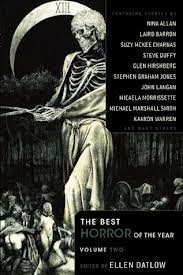
The Best Horror of the Year, Volume 2, Ellen Datlow (ed).

9781597801737
Night Shade Books, 2010
308 pp

softcover


I'm really liking this aimless reading thing; I love being all over the map with my book choices.  Good horror anthologies or novels are my secret indulgence; I love that feeling of dread that creeps up on me while I'm reading.  I save these books for reading in the dead of night when it's quiet.


I read the first entry in this series at the end of February and it was just plain bad, so I was happily surprised to find that there had been an improvement in quality between the publication of the first and the second volumes. There are five little gems that shine above all of the rest in this book -- so if you're into horror, you might want to check it out.